
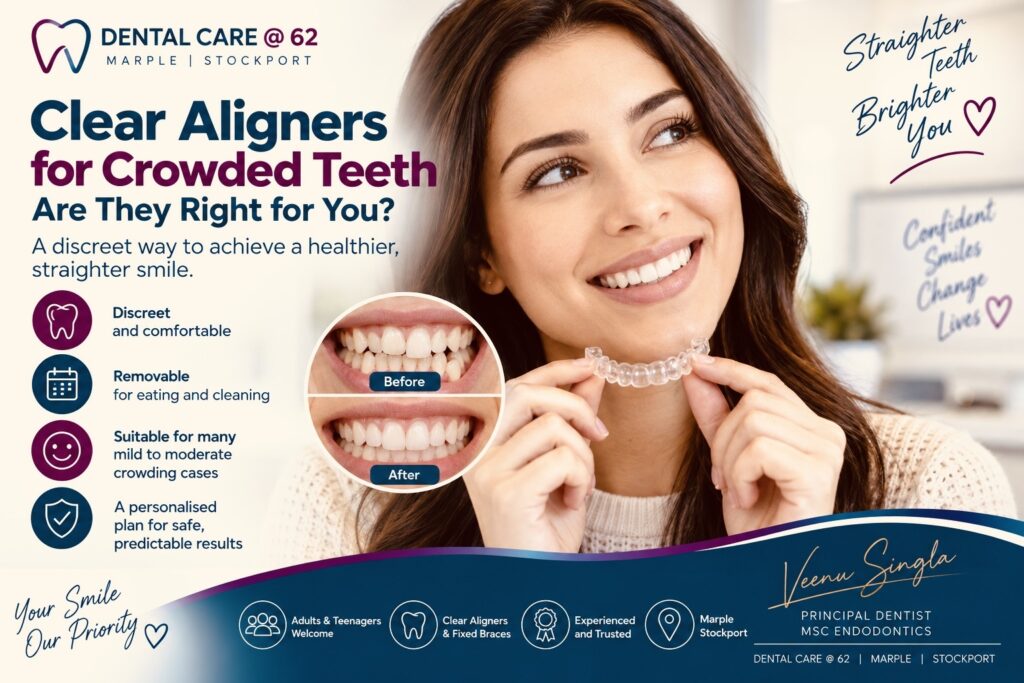
Crowded teeth can make brushing and flossing more difficult, affect how your bite feels and leave some people self-conscious about their smile. Clear aligners for crowded teeth can be an effective option for many adults and teenagers, but they are not automatically the right choice for every degree or type of crowding. A careful orthodontic assessment is the starting point.
At Dental Care @ 62, treatment planning is based on your teeth, gums, bite and goals – not simply on whether clear aligners are popular or discreet. For patients in Marple, Stockport and the surrounding area, this means a clear explanation of what is realistically achievable and the alternatives worth considering.
At Dental Care @ 62, we provide clear aligner treatment using systems including 32Co and Invisalign, depending on the individual case and patient preference. The important question is not simply which brand of aligner to choose, but whether clear aligners are clinically appropriate for the tooth movements required. Fixed braces may sometimes provide a more suitable alternative.
Dr Veenu Singla, Principal Dentist at Dental Care @ 62, has a special interest in orthodontics and provides clear aligner and fixed-brace treatment. Each case is assessed individually, taking into account tooth position, bite, gum health and the complexity of the movements required before treatment is recommended.
Can clear aligners straighten crowded teeth?
Yes, in many cases. Clear aligners are a series of close-fitting, removable plastic trays designed to move teeth gradually. Each set is worn for a prescribed period before progressing to the next, with regular reviews to check that treatment is moving as planned.
They can be suitable for mild to moderate crowding, and may also be appropriate for some more involved cases. The deciding factors are not just how crooked the front teeth look. Your clinician will assess the amount of space available, the position of tooth roots, the health of your gums, the way your upper and lower teeth meet, and whether tooth movements are predictable with removable aligners.
Crowding sometimes occurs because the jaw does not have enough room for all the teeth. It can also develop when teeth shift over time, following early tooth loss, or as a result of the natural shape and size of the teeth and jaws. Understanding the cause helps determine whether aligners alone are appropriate.
How space is made safely
Straightening crowded teeth requires space. It would not be healthy simply to push teeth outwards beyond the supporting bone and gums, so this part of planning deserves particular care.
Depending on the individual case, space may be created by gently widening the dental arch within suitable limits, moving back teeth slightly, reducing tiny amounts of enamel between selected teeth, or, less commonly, removing a tooth. Enamel reduction, often called interproximal reduction or IPR, is measured carefully and is not the same as filing teeth down indiscriminately.
In some cases, crowding is linked to missing, heavily restored or poorly positioned teeth. The best plan may involve restorative treatment or a different orthodontic approach rather than aligners alone. Where imaging is clinically indicated, appropriate radiographs help assess roots, bone levels and unerupted teeth. More detailed imaging is only considered when it is likely to add useful information to treatment planning.
What treatment with clear aligners involves
After an initial consultation, records are taken to build an accurate picture of your mouth. These may include digital scans, photographs and X-rays where needed. Your clinician then discusses the proposed tooth movements, likely timescale, fees, limitations and any preparatory dental work required before you decide whether to proceed.
Most aligner plans use small tooth-coloured attachments. These are temporary shapes bonded to certain teeth to give the aligners a better grip and help control movement. They are often discreet, although they can be visible close up and may make the teeth feel less smooth while treatment is underway.
Clear aligners generally need to be worn for most of the day and night, commonly around 20–22 hours daily depending on the aligner system and the instructions provided for your individual treatment. They should usually be removed for eating and drinking anything other than water, then teeth should be brushed before putting them back in. This commitment is central to success. A treatment plan may look suitable on paper, but if wearing trays consistently will be difficult, fixed braces may offer more reliable control.
Appointments are generally shorter and less frequent than adjustment visits for some fixed braces, although monitoring remains important. Teeth do not always move exactly as predicted, so additional aligners, known as refinements, can sometimes be needed to improve the final result.
The day-to-day advantages
For the right patient, clear aligners offer practical benefits. They are removable for meals, which can make food choices easier than with fixed braces. Being able to take them out for brushing and cleaning between teeth can also support good oral hygiene, provided the aligners are worn again promptly.
Their appearance is another reason many adults choose them. The trays are transparent and generally less noticeable than brackets and wires. They can also be removed briefly for an important occasion, though frequent or prolonged removal can delay progress.
When fixed braces may be the better option
Clear aligners are not inherently better than fixed braces. Both can straighten teeth successfully, and the most suitable appliance depends on the movements required and how it will fit into your life.
Fixed braces may be advised where there is significant crowding, complex bite correction, severely rotated teeth, a need for more precise tooth movement, or concerns about aligner wear. Because braces remain attached to the teeth, they do not depend on remembering to put trays back in after meals or before bed.
Some patients also prefer the simplicity of having one appliance in place throughout treatment. Others value the removability and discreet appearance of aligners. During a consultation, it is reasonable to ask why one option is being recommended and what compromises, if any, come with the alternatives.
Healthy teeth and gums come first
Orthodontic treatment moves teeth through the supporting bone, so active gum disease, untreated decay, repeated infections or poor plaque control should be addressed first. Starting tooth movement before the mouth is stable can increase avoidable risks and make long-term outcomes less favourable.
Crowded teeth can create hard-to-clean areas, particularly behind lower front teeth or where teeth overlap. Before and during treatment, careful brushing with fluoride toothpaste and daily cleaning between teeth are essential. Your dental team can demonstrate techniques that suit your particular arrangement of teeth and any attachments or appliances.
For patients who feel anxious about dental appointments, the process can be broken into manageable stages. You should have time to ask questions, understand what is being proposed and raise any concerns about scans, impressions, cleaning or treatment visits. Orthodontic care works best as a shared plan, not something done in a rush.
Retainers protect the result
Once crowded teeth have been straightened, retainers are needed to help hold them in their new positions. Teeth can continue to shift throughout adult life, whether or not someone has had orthodontic treatment.
A removable retainer, a discreet fixed wire behind the teeth, or a combination of both may be recommended. Retainer wear is a long-term commitment, and replacement may be needed if a removable retainer is lost, cracked or no longer fits. This is an important part of the discussion before treatment starts, not an afterthought at the end.
Questions worth asking at your consultation
A useful consultation should leave you clearer about your choices. Ask whether aligners can achieve the changes you want, how much daily wear they require, whether enamel reduction or attachments are likely, and what happens if teeth do not track as expected. It is also sensible to ask about expected treatment duration, retainers, follow-up care and the full cost of treatment, including any likely refinements.
Photographs or digital simulations can help explain the intended result, but they are planning tools rather than a promise. Biology, wear habits and oral health all influence how treatment progresses.
Considering clear aligners for crowded teeth in Stockport?
Dental Care @ 62 in Marple provides clear aligner and fixed-brace treatment for suitable adults and teenagers. We offer clear aligner systems including 32Co and Invisalign, with treatment recommendations based on your teeth, bite, oral health and the movements required — rather than simply choosing an appliance by brand.
If you are considering clear aligners for crowded teeth in Stockport or Marple, a personal orthodontic assessment can help you understand whether aligners are appropriate for your teeth and bite.
Contact Dental Care @ 62 to arrange an orthodontic assessment and discuss which options may be appropriate for you.
0 comments on “Clear Aligners for Crowded Teeth: Are They Right for You?”