
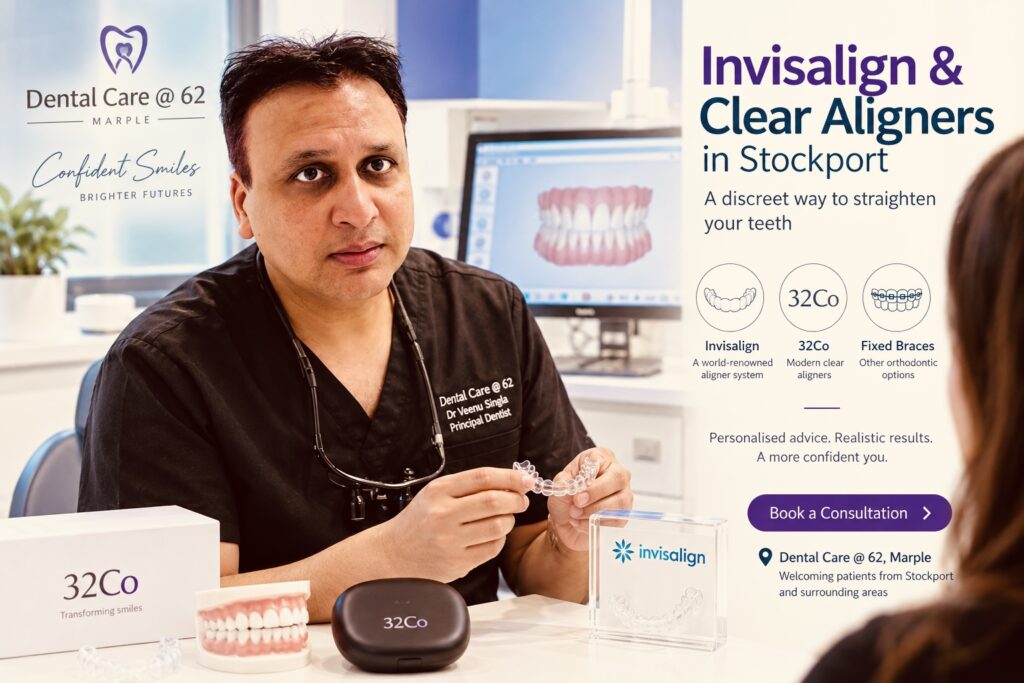
A smile that looks slightly crowded in photographs, a tooth that has gradually moved since earlier braces, or a gap you have always noticed can be enough to make you consider orthodontic treatment. For adults and teenagers looking into Invisalign Stockport, clear aligners can be a discreet and flexible way to straighten teeth – but they are not automatically the right answer for every smile.
The value of a consultation is not simply being told whether aligners are possible. It is understanding what is causing the concern, what a realistic result looks like, how treatment may affect your bite, and whether clear aligners, fixed braces or no treatment at all is the most appropriate choice for you.
What is Invisalign treatment?
Invisalign is one of the best-known clear aligner systems, but it is not the only clear aligner option available. At Dental Care @ 62, we offer clear aligner treatment using systems including 32Co and Invisalign, depending on the individual case, treatment requirements and patient preference. Following a full assessment, we can discuss the available options and explain which approach may be appropriate for you.
Invisalign is a system of clear, removable orthodontic aligners. Each aligner is made to fit closely over the teeth and is worn in a planned sequence, moving selected teeth gradually over time. Rather than brackets and wires being fixed to the teeth, you move on to the next set of aligners as directed by your dentist or orthodontic clinician.
The aligners are transparent, although they are still visible at close range. Small tooth-coloured attachments are often needed to give the aligners a better grip and help create particular movements. These are usually discreet, but it is helpful to know about them before treatment begins. Some patients may also need small adjustments between teeth, known as interproximal reduction, to create the space required for safe alignment.
Clear aligners are removed for meals and for brushing and cleaning between the teeth. For them to work predictably, they generally need to be worn for around 20 to 22 hours each day. That level of commitment is one of the most important factors in deciding whether they will suit your routine.
Who may be suitable for Invisalign or clear aligners?
Clear aligners may be suitable for many common orthodontic concerns, including mild to moderate crowding, spacing, teeth that have relapsed after previous orthodontic treatment, and some bite problems. They can be particularly appealing to adults who would prefer an alternative to visible fixed braces at work, social occasions or family events.
Suitability depends on much more than how straight the front teeth appear. The way your upper and lower teeth meet, the position of tooth roots, gum health, existing crowns or fillings, jaw growth in younger patients, and the movements required all matter. A smile can look straightforward from the front but still need careful planning.
For more complex tooth movements or significant bite correction, fixed braces may offer greater control. This does not make one option universally better than the other. It means the treatment should be selected for the clinical problem, not simply for its appearance. In some cases, a combined approach or treatment with another type of appliance may be discussed.
Healthy teeth and gums come first
Orthodontic treatment moves teeth through the supporting bone, so it should begin with a sound dental foundation. Active gum disease, untreated decay, repeated infections or poorly fitting restorations may need attention before tooth straightening starts.
This is especially relevant if it has been some time since your last dental examination, or if you have noticed bleeding gums, sensitivity, loose teeth or pain on biting. Addressing these concerns first can help protect the long-term health of your teeth and gums.
What happens at a clear aligner consultation?
A good orthodontic consultation should feel unhurried and informative. You should have the opportunity to explain what you would like to change, as well as any concerns about comfort, appearance, timing or previous dental experiences.
Your clinician will assess your teeth, gums and bite, and may take photographs, digital scans and radiographs where appropriate. These records help with diagnosis and treatment planning. Digital simulations can be useful for showing a likely direction of treatment, but they are planning tools rather than a promise of an exact outcome. Teeth and gums respond differently from person to person, and treatment plans sometimes need adjusting as care progresses.
You should also be told about the likely length of treatment, the need for attachments or tooth reshaping if relevant, how many review appointments may be needed, and what retention will involve afterwards. It is reasonable to ask what alternatives exist and what may happen if you decide not to proceed.
At Dental Care @ 62 in Marple, treatment planning is approached around the individual patient, with clear explanations and time to make an informed decision. This can be particularly reassuring if you feel nervous about dental treatment or have had a disappointing experience elsewhere.
Living with clear aligners day to day
The practical advantages of aligners are clear for many people. You can take them out to eat, brush and floss, and there are no fixed wires or brackets. However, removable treatment also places more responsibility in the patient’s hands.
Aligners should only be removed for meals, drinks other than plain water, and cleaning. Leaving them out for long periods can slow treatment and may mean that the next aligner no longer fits as intended. They should be cleaned gently, stored safely in their case when not in use, and never wrapped in a napkin where they can easily be thrown away.
It is common to notice pressure or tenderness for a short time when starting a new aligner. Some pressure or tenderness can be expected when starting a new aligner and usually settles as you adjust to it, but severe pain, a sharp edge, an aligner that will not seat properly, or a damaged attachment should be checked promptly. Regular reviews allow progress to be monitored and any concerns to be addressed early.
Treatment time varies
Some limited alignment cases may take only a few months, while more involved treatment can take a year or longer. The original plan, wear time, missed or damaged aligners, biological response and whether refinement aligners are needed can all affect the timetable.
Be cautious of treatment being presented as a quick cosmetic fix without a proper assessment of the bite and dental health. Straightening visible front teeth may be part of the aim, but a considered plan should also take account of function, stability and the condition of the surrounding teeth and gums.
Retainers are part of the result
Teeth can move throughout life, even after a successful course of orthodontic treatment. Retainers help hold them in their new positions while the supporting tissues adapt, and they remain an important long-term part of protecting the result.
Your clinician may recommend removable retainers, fixed retainers bonded behind certain teeth, or a combination of both. Retainers need ongoing care and occasional review. A fixed retainer can break or collect plaque if cleaning is difficult, while a removable retainer only works when it is worn. The most suitable approach depends on your bite, the movements completed and what you can realistically maintain.
Invisalign and 32Co clear aligners
Invisalign is a widely recognised clear aligner brand, but other clear aligner systems are also available. At Dental Care @ 62, we commonly provide 32Co clear aligners, while Invisalign treatment is also available for patients where it is appropriate or preferred. Rather than choosing treatment based on a brand name alone, we believe the starting point should be a proper orthodontic assessment. The complexity of the tooth movements, your bite, dental and gum health, lifestyle and treatment goals all need to be considered.
We can then discuss the suitable treatment options with you, including clear aligners or fixed braces, together with their respective advantages and limitations.
Clear aligners or fixed braces?
The choice often comes down to the type of tooth movement required and how treatment will fit into everyday life. Clear aligners are removable and discreet, but demand consistent wear. Fixed braces work continuously because they stay in place, and may be a more suitable option when movements are more complex or compliance may be difficult.
For teenagers, the decision should take account of growth, oral hygiene, sport, school routines and the likelihood of wearing aligners as directed. Parents should feel comfortable asking how different options may affect treatment goals, appointments and retention. For adults, existing dental work and the health of the gums can be equally significant considerations.
The right option is the one that provides an appropriate, well-explained plan and that you feel able to follow reliably.
The British Orthodontic Society provides further patient information about clear aligner treatment and its suitability.
Choosing Invisalign care in Stockport
When comparing clear aligner providers, look beyond before-and-after images. Ask who will assess your bite and dental health, how often your progress will be reviewed, what happens if teeth do not track as planned, and whether retainers and any refinement stages are included in the proposed care.
It is also worth considering convenience. Regular reviews should be accessible enough that you can attend as advised, whether you live in Marple, Hazel Grove, Bramhall, Cheadle or elsewhere in South Manchester and Cheshire. A local practice that also provides routine dental care can be helpful, as your wider oral health remains relevant throughout orthodontic treatment.
Considering Invisalign or clear aligners in Stockport?
Dental Care @ 62 in Marple offers orthodontic assessment and a range of tooth-straightening options, including 32Co clear aligners, Invisalign and fixed braces. Following a detailed assessment of your teeth, gums and bite, we can explain which options may be suitable and help you make an informed choice.
Contact Dental Care @ 62 to arrange a clear aligner consultation and discuss your treatment options.
📍 Marple, Stockport – welcoming patients from Stockport and surrounding areas.
One comment for “Invisalign & Clear Aligners in Stockport: Which Option Is Right for You?”
Clear Aligners for Crowded Teeth | Dental Care @ 62
[…] in many cases. Clear aligners are a series of close-fitting, removable plastic trays designed to move teeth gradually. Each set […]