
A persistent toothache can make eating, sleeping and concentrating feel difficult. Root canal treatment Stockport patients seek is often recommended when the soft tissue inside a tooth, known as the pulp, has become inflamed or infected. Although the phrase can sound daunting, modern endodontic treatment is a careful, planned way of relieving infection and, wherever appropriate, preserving your natural tooth.
At Dental Care @ 62 in Marple, we take time to understand what is causing your symptoms, explain the findings clearly and discuss whether root canal treatment is the right option for you. There is no one-size-fits-all answer: the condition of the tooth, the extent of infection and the long-term restoration needed all matter.
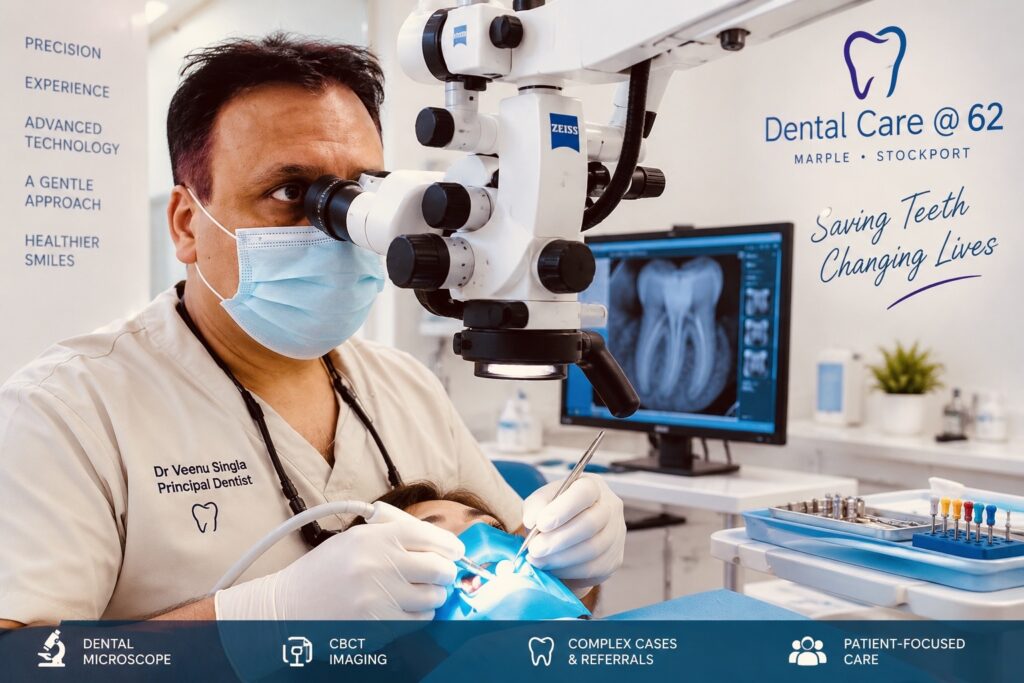
Dr Veenu Singla, Principal Dentist at Dental Care @ 62, holds an MSc in Endodontics from the University of Manchester and has a special interest in root canal treatment.
What is root canal treatment?
Each tooth contains a central space with pulp tissue, including nerves and blood vessels. Deep decay, a crack, repeated dental work or an injury can allow bacteria to reach this tissue. The pulp may then become inflamed or infected, causing pain, sensitivity, swelling or sometimes no obvious symptoms at all.
Root canal treatment, also called endodontic treatment, involves removing the infected or damaged pulp, carefully cleaning the fine channels inside the root and sealing them to reduce the risk of bacteria re-entering. The tooth is then restored, often with a filling and, in many cases, a crown or other protective restoration.
The aim is not simply to settle an immediate toothache. It is to retain a tooth that can function comfortably and reliably, provided there is a sound enough foundation to restore it.
Signs you may need root canal treatment in Stockport
Tooth pain is a common reason for an appointment, but not every painful tooth needs root canal treatment. Equally, an infected tooth does not always hurt. Assessment is therefore essential.
Symptoms that may need prompt attention include lingering sensitivity to hot or cold, pain when biting, a recurring gum swelling, a darkened tooth, facial swelling or an unpleasant taste around a tooth. A severe, throbbing toothache can indicate infection, particularly if it affects sleep or worsens when you lie down.
If swelling is spreading, you feel unwell, or you have difficulty swallowing or breathing, seek urgent medical advice. For dental pain, an early dental assessment can often prevent the problem becoming more complicated. Antibiotics alone do not usually remove infection from inside a tooth; the source needs to be treated where appropriate.
How we decide whether treatment is suitable
A proper diagnosis comes before treatment. We will ask about your symptoms and dental history, examine the tooth and surrounding gums, and take appropriate X-rays. Tests may also help us establish whether the pulp is healthy, inflamed or infected, and whether a neighbouring tooth could be responsible for the pain.
For more complex cases, in-house CBCT imaging may provide a three-dimensional view of the roots, bone and nearby structures. This can be particularly useful where root anatomy is unusual, previous treatment has not settled the problem, or a conventional X-ray does not provide enough information. A CBCT scan is not needed for every patient, so it is only recommended when its additional detail is likely to inform care.
We also consider whether the tooth can be restored after treatment. A tooth with extensive decay, a vertical root fracture or insufficient healthy structure may have a guarded outlook. In these circumstances, we will discuss the realistic benefits and limitations of root canal treatment alongside alternatives such as extraction and replacing the tooth, or, in selected situations, monitoring.
What happens during root canal treatment?
Treatment is usually carried out over one or more appointments. The number depends on the tooth, the complexity of its root system, the degree of infection and how it responds during treatment.
A local anaesthetic is used to numb the area. Many patients are reassured to find that the treatment itself is no more difficult to manage than having a routine filling, although a very inflamed tooth can sometimes be more challenging to numb fully. Please tell us if you are nervous or have had a difficult dental experience before. We can agree a pace that feels manageable, explain each stage and arrange breaks when needed.
Once the tooth is isolated and protected, a small opening allows access to the root canals. Very fine instruments are used to clean and shape each canal, alongside disinfecting solutions that help remove bacteria and debris. At Dental Care @ 62, a dental operating microscope can assist with magnification and illumination in appropriate cases, helping the clinician assess the intricate internal anatomy of a tooth.
The canals are then sealed. If the infection is extensive or the tooth needs further settling time, a temporary dressing may be placed before a later appointment. Finally, the tooth needs a secure restoration. Teeth requiring root canal treatment have often already lost significant tooth structure through decay, cracks or previous restorations. Depending on the amount of remaining tooth structure, a crown, onlay or other cuspal-covering restoration may be recommended to help reduce the risk of fracture.
Aftercare and recovery
It is normal for the area to feel tender for a few days, especially when biting. This is usually manageable with suitable over-the-counter pain relief, taken only as directed and if it is safe for you to use. We will give you personalised aftercare advice and explain when to contact us.
Avoid chewing hard foods on a tooth with a temporary restoration, and attend any planned follow-up appointments. Once the final restoration is in place, daily brushing, cleaning between the teeth and regular dental reviews remain important. Root canal treatment deals with infection inside the tooth, but the tooth can still be affected by new decay, gum disease or fracture.
Treatment outcomes depend on several factors, including the original condition of the tooth, the complexity of its roots, the quality of the final restoration and ongoing oral health. Even a successfully treated tooth may need monitoring over time.
Root canal treatment or extraction?
Extraction can sometimes be the most appropriate option, particularly if a tooth cannot be predictably restored. However, keeping a natural tooth can avoid the need to replace a gap and may help maintain normal biting function.
If extraction is being considered, it is worth discussing what happens afterwards. Leaving a space may be suitable in some mouths, while in others the neighbouring teeth can drift or the bite can change. Replacement options may include a bridge, denture or dental implant, each with different timescales, costs, maintenance needs and clinical considerations.
There is no universal right choice. The most appropriate decision is one made with a clear understanding of the likely prognosis, alternatives and your own priorities.
Complex cases and professional referrals
Some teeth have curved, narrow or calcified canals, previous root fillings, large infections or anatomy that makes treatment more involved. Dental Care @ 62 accepts professional referrals for appropriate complex endodontic cases from dentists across Stockport, South Manchester and Cheshire. Dental Care @ 62 also welcomes referrals from dental colleagues for assessment and management of appropriate complex endodontic cases. Dr Veenu Singla holds an MSc in Endodontics and has a particular interest in the management of more challenging root canal cases. Dental operating microscopy and in-house CBCT imaging are available where clinically appropriate to aid assessment and treatment planning. Advanced assessment tools, including CBCT imaging and dental microscopy, can support careful treatment planning for selected cases.
For patients, being referred does not mean a treatment will automatically go ahead. It means the tooth can be assessed in detail and the options considered carefully. We aim to communicate clearly with both the patient and referring dentist so that ongoing care is coordinated.
A calm approach to tooth preservation
Root canal treatment is not something to put off when a tooth is painful or infected, but it should never feel rushed or unexplained. Whether you are in Marple, Hazel Grove, Bramhall, Cheadle or elsewhere in the Stockport area, arranging an assessment gives you the opportunity to understand what is happening and make an informed decision.
If you are worried about a tooth, have swelling or have been told you may need root canal treatment, contact Dental Care @ 62 to arrange an appointment. A clear diagnosis and a calm conversation are often the most helpful first steps towards protecting your dental health.
One comment for “Root Canal Treatment in Stockport: Can an Infected Tooth Be Saved?”
Toothache at Night? What to Do | Dental Care @ 62
[…] dental nerve. When there is an infection, treatment to remove the source – such as drainage, root canal treatment or extraction where appropriate – is often what resolves it. A dentist can assess whether […]