
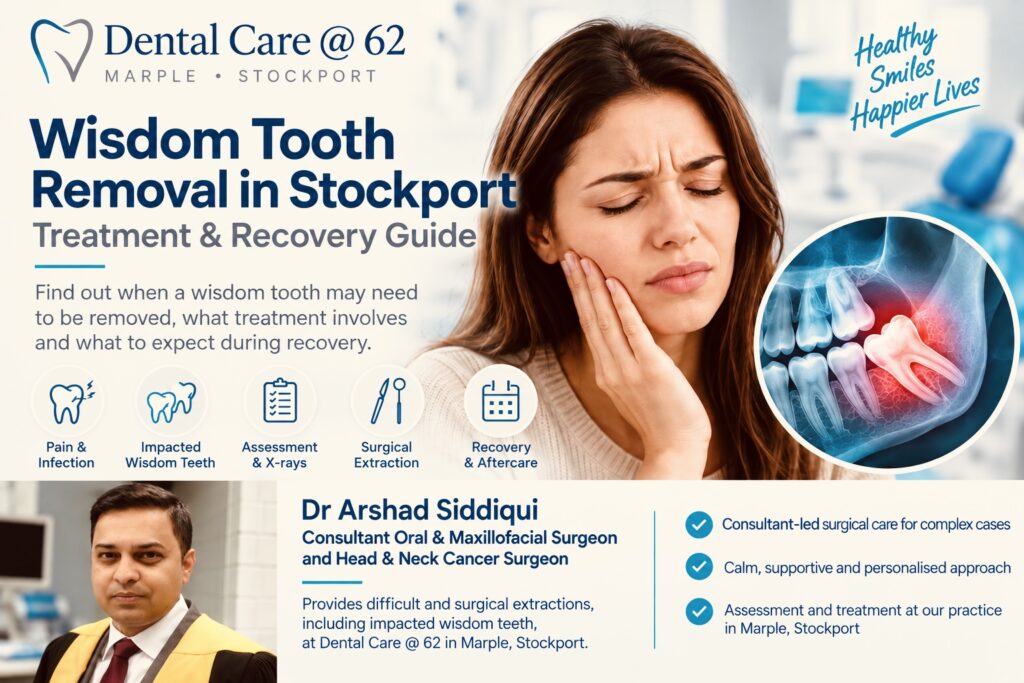
If you are considering wisdom tooth removal in Stockport, you may be experiencing repeated pain, swelling or infection around a wisdom tooth. A lower wisdom tooth that repeatedly flares up can make eating, sleeping and concentrating unexpectedly difficult. This guide explains why removal may be recommended, how a wisdom tooth is assessed, what treatment involves and how to look after yourself afterwards.
When does a wisdom tooth need to be removed?
Wisdom teeth are the final adult molars to develop, usually appearing from the late teens into the twenties, although this varies. Some come through fully, sit in a position that can be cleaned well and cause no difficulty. In that situation, removal may not be necessary.
Wisdom teeth are not routinely removed simply because they are impacted or have not fully erupted. If a wisdom tooth is healthy and is not causing disease or other problems, monitoring may be appropriate. The decision to remove it should be based on clinical findings, symptoms and the risks and benefits for the individual patient.
Problems arise when there is not enough room for the tooth to erupt properly, leaving it partially covered by gum or trapped against the tooth in front. Food and bacteria can collect around the area, leading to inflammation or infection of the gum, known as pericoronitis. A wisdom tooth may also be associated with decay, gum disease, damage to the neighbouring molar or, less commonly, a cyst.
Your dentist will consider the whole picture rather than recommending extraction simply because a wisdom tooth is present. Monitoring, improved cleaning advice and treatment of a short-term flare-up can sometimes be appropriate. However, repeated infection, persistent pain, decay that cannot be predictably restored or harm to the neighbouring tooth may make removal the sensible long-term option.
Wisdom Tooth Removal in Stockport: Assessment and Planning
A careful assessment helps make treatment safer and more predictable. Your dentist will ask about your symptoms, medical history and any medicines you take, then examine the area and take suitable X-rays.
For many cases, conventional dental imaging provides the information needed for assessment. In selected more complex lower wisdom tooth cases, particularly where conventional imaging suggests a close relationship between the roots and the nerve supplying sensation to the lower lip and chin, CBCT may provide additional three-dimensional information to help with treatment planning. CBCT is not routinely required before wisdom tooth removal and should only be used where clinically justified.
The consultation is also the time to discuss alternatives, expected healing and the risks relevant to you. If you are anxious, say so early. Many people feel more comfortable when they understand each stage and can agree a simple signal to pause during treatment.
Most wisdom tooth extractions can be carried out under local anaesthetic. If additional anxiety management or sedation may be appropriate, the available options can be discussed and, where necessary, appropriate arrangements or referral can be considered.
At Dental Care @ 62, more complex wisdom tooth and surgical extraction cases can be assessed and treated by Dr Arshad Siddiqui, Consultant Oral & Maxillofacial Surgeon and Head & Neck Cancer Surgeon. Dr Siddiqui provides difficult and surgical extractions, including impacted wisdom teeth, at the practice in Marple.
What happens during the extraction?
Before treatment begins, the area is numbed with local anaesthetic. You should not feel sharp pain, though you may notice pressure, pushing or vibration. Tell the clinician if you are uncomfortable at any point so that the anaesthetic can be reviewed.
A fully erupted wisdom tooth may be removed in a similar way to another tooth. If it is impacted, meaning partly or fully held within the gum or bone, a minor surgical procedure may be needed. The gum is carefully lifted, a small amount of bone may be removed and the tooth may be divided into smaller sections before it is taken out. This allows the tooth to be removed with appropriate care for the surrounding tissues.
Dissolving stitches are sometimes used. A gauze pack is placed over the site and you will be asked to bite on it firmly for a period afterwards to help a blood clot form. This clot is an essential part of healing, so the first day or two of aftercare matters.
The length of an appointment varies considerably. A simple extraction may be relatively quick, while a deeply impacted tooth requires more planning and time. It is better to allow enough time for clear explanations and unhurried care than to focus on the clock.
Recovery after wisdom tooth removal
Most people experience some swelling, jaw stiffness and discomfort after an extraction, particularly following a surgical lower wisdom tooth removal. Symptoms often increase over the first two to three days before gradually settling. Planning a quieter couple of days, where possible, is sensible.
Take the pain relief recommended by your dentist or oral surgeon, following the instructions on the label and checking that it is suitable alongside your usual medicines or health conditions. Avoid taking aspirin for post-extraction pain unless a clinician has advised it, as it can increase bleeding.
For the first 24 hours, avoid rinsing forcefully, spitting repeatedly, smoking or vaping, and drinking alcohol. These actions can disturb the blood clot. Choose cool or lukewarm soft foods once the numbness has worn off, and avoid very hot drinks initially. A cold pack wrapped in a cloth and held against the cheek intermittently can help limit swelling.
From the day after surgery, gentle warm saltwater rinses can help keep the area clean. Brush the rest of your mouth as normal, taking care around the extraction site. Good oral hygiene supports healing, but there is no need to scrub the socket itself.
If you have been given sedation, arrange for a responsible adult to take you home and stay with you as advised. Do not drive, operate machinery, drink alcohol or make important decisions until the effects have fully worn off.
Understanding the possible risks
Every extraction has risks, but these are discussed so you can make an informed decision, not to cause alarm. Bleeding and swelling are expected to some degree. Infection can occur, and dry socket is a painful condition in which the blood clot is lost or breaks down too early. It is more likely in smokers and after difficult extractions, which is one reason smoking and vaping should be avoided during healing.
In selected lower wisdom tooth cases where complete removal may carry a higher risk of injury to the inferior alveolar nerve, coronectomy may be considered. This involves removing the crown of the wisdom tooth while intentionally retaining the roots. It is not suitable for every case and has its own potential complications and follow-up requirements, which should be discussed as part of the consent process.
Contact your dental team promptly if bleeding does not settle despite following the postoperative instructions, if pain or swelling is worsening rather than gradually improving, or if you develop fever, an unpleasant taste or other concerns. Severe swelling of the mouth, throat or neck, or difficulty breathing, speaking or swallowing, requires urgent medical attention.
Questions patients often ask
Can I go back to work after a wisdom tooth extraction?
It depends on the complexity of the procedure, the nature of your work and how you feel afterwards. Some people return to light duties the next day after a simple extraction. For a surgical extraction, taking two or three days away from demanding work may be more comfortable. If your role involves physical exertion, speak with your clinician about a suitable plan.
Will removal affect my other teeth?
Removing a problematic wisdom tooth should not cause the other teeth to move. In fact, treating a difficult wisdom tooth may protect the molar in front from decay or gum damage. Each case is assessed individually, especially where the neighbouring tooth already needs treatment.
What if I am nervous about the appointment?
Dental anxiety is common and nothing to be embarrassed about. Let the team know when arranging your appointment. A calm discussion, a clear treatment plan, breaks when needed and appropriate pain-control or sedation options can make the experience more manageable. You remain involved in decisions throughout your care.
At Dental Care @ 62 in Marple, patients from Stockport and the surrounding area can discuss wisdom tooth concerns in a calm, non-judgemental setting. If a wisdom tooth is causing pain, repeated gum infections or concern, arranging an assessment can provide clarity before the problem becomes more disruptive.
0 comments on “Wisdom Tooth Removal in Stockport: Treatment & Recovery Guide”