
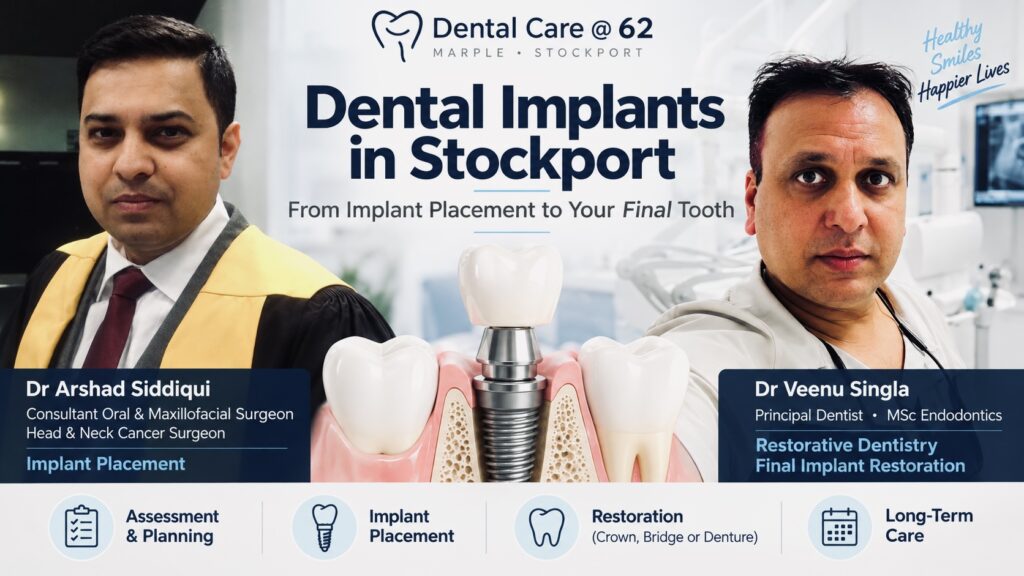
If you are considering dental implants in Stockport, you may be looking for a fixed way to replace one or more missing teeth. A missing tooth can affect more than your smile — it may change how you chew, what you eat and how confident you feel when speaking or smiling. This guide explains how dental implants work, who may be suitable and what the treatment journey can involve. At Dental Care @ 62 in Marple, treatment starts with an individual assessment of your teeth, gums, bite, general health and available bone before the appropriate options are discussed.
What is a dental implant?
A dental implant is a small titanium fixture placed in the jawbone to replace a tooth root. Once it has integrated with the bone, it can support a crown for one missing tooth, a bridge for several teeth or, in some circumstances, a removable denture.
The visible tooth is not fitted at the same time in every case. Implant treatment is usually completed in stages, allowing the implant and surrounding bone to heal before a carefully made crown, bridge or denture is attached. The result should be designed to feel comfortable, function well and sit naturally alongside your other teeth.
Unlike a conventional bridge, an implant-supported crown does not usually require the teeth either side of the gap to be reduced. This can be a meaningful advantage where neighbouring teeth are healthy. However, it also involves a surgical procedure, a longer treatment timeline and a commitment to excellent cleaning and review appointments.
Who may be suitable for implant treatment?
Many adults with one or more missing teeth can be considered for implants, including people who have worn a denture for some time. Suitability depends less on age alone and more on your general health, gum condition, bone levels, bite and expectations.
Healthy gums are particularly important. Untreated gum disease can affect the tissues that support an implant, just as it affects natural teeth. Smoking can also increase the chance of healing complications and longer-term implant problems. This does not necessarily rule treatment out, but it should form part of an honest discussion about risk and the value of reducing or stopping smoking.
Some medical conditions and medicines require additional planning. For example, diabetes should be well controlled, and certain drugs used for bone conditions may influence the approach to dental surgery. A full medical history is therefore essential.
Why detailed imaging matters
Conventional dental X-rays may provide much of the information required during initial assessment. Where additional three-dimensional information is clinically justified, CBCT imaging can help assess available bone and the relationship of the proposed implant site to important anatomical structures such as nerves and sinuses. CBCT is not required for every patient and should be prescribed according to the individual clinical situation.
At Dental Care @ 62, dental implant placement is provided for suitable patients by Dr Arshad Siddiqui, Consultant Oral & Maxillofacial Surgeon and Head & Neck Cancer Surgeon. Implant treatment is planned around the individual patient, with the surgical and restorative stages coordinated to achieve a functional, maintainable replacement for the missing tooth or teeth.
Good planning also considers the final tooth first. The aim is not simply to place an implant in available bone, but to plan a restoration that can be cleaned, functions properly and supports a balanced bite.
Dental implants in Stockport: The Treatment Stages
Every case is different, but most implant treatment follows a considered sequence.
1. Consultation and treatment planning
Your dentist will examine your mouth, discuss your medical history and take appropriate X-rays or scans. They will assess your teeth, gums, jawbone and bite, as well as the appearance of the proposed replacement tooth. If a tooth is still present but has a poor outlook, the team should also explain whether preserving it through restorative treatment or root canal treatment remains a reasonable option.
This is an important ethical point: implants can be an excellent solution for missing teeth, but they are not a reason to remove a treatable natural tooth. Where tooth preservation is predictable and appropriate, it should be discussed.
You should receive a clear outline of the proposed treatment, likely timescale, fees, alternatives and relevant risks before deciding whether to proceed.
2. Preparing the mouth
Some patients can proceed directly to implant placement. Others may need gum treatment, a tooth extraction, treatment for infection or time for an extraction socket to heal first. If there is insufficient bone in the planned position, grafting may be considered to create a more favourable foundation.
Bone grafting can extend the overall treatment time, often by several months. It is not needed in every case, and whether it is worthwhile depends on the amount and position of missing bone, the desired restoration and the alternatives available.
3. Implant placement
Implant placement is carried out using local anaesthetic. For anxious patients, the appointment can be planned with extra time, clear explanations and comfort breaks. The implant is placed into the jawbone through the gum, and the area is usually closed with stitches where needed.
Some tenderness, swelling or bruising can occur following implant placement. The amount varies according to the procedure and the individual patient. You will be given appropriate postoperative advice, including guidance on pain relief, eating and cleaning the area.
4. Healing and integration
Over the following weeks or months, the bone heals around the implant in a process called osseointegration. The exact timing varies according to the site, bone quality, whether grafting was required and how secure the implant was at placement.
In selected cases, a temporary tooth may be fitted during healing. In others, it is safer or more practical to leave the area without a fixed temporary restoration, or to use a removable temporary option. Your dentist will explain what is realistic for your situation rather than promising a particular timetable.
5. The final restoration
Once healing is satisfactory, the implant is prepared to receive its crown, bridge or denture. Impressions or digital records are taken so the final restoration can be shaped and shaded appropriately. Your bite is checked carefully, as excessive force can place unnecessary strain on an implant and its components.
The final tooth should be reviewed not only for appearance, but for access to cleaning. An implant crown cannot decay, but the gum and bone around it can still become inflamed if plaque is allowed to build up.
Recovery, aftercare and long-term maintenance
Implant care is a partnership. Daily brushing remains essential, and you may be advised to use interdental brushes, floss designed for implants or other cleaning aids depending on the shape of your restoration. Regular professional hygiene care and reviews allow the gums, bite and implant components to be monitored.
Early warning signs such as bleeding gums, swelling, a bad taste, discomfort when biting or a feeling that the crown is loose should be assessed promptly. Problems around implants are often easier to manage when identified early.
An implant is intended to be a long-term replacement option, but it is not maintenance-free and no dental treatment can be guaranteed indefinitely. Its outlook is influenced by cleaning, smoking, gum health, medical factors, bite forces and attendance for review.
Benefits, limitations and alternatives
For the right patient, an implant can provide a fixed replacement tooth that does not rely on neighbouring teeth for support. It may improve chewing confidence and can help preserve bone around the implant site compared with leaving the area without a tooth replacement, although changes to the surrounding tissues can still occur over time. Implant-supported dentures can also offer improved stability for some people who struggle with a loose lower denture.
The trade-offs are equally worth understanding. Treatment takes time, involves surgery and may require grafting or additional procedures. There is a small risk of infection, delayed healing, implant failure, nerve disturbance in certain lower-jaw cases, sinus-related issues in certain upper-jaw cases, and later inflammation around the implant. Careful assessment helps reduce risk, but cannot remove it completely.
Inflammation confined to the soft tissues around an implant is known as peri-implant mucositis. More advanced inflammation associated with loss of supporting bone is known as peri-implantitis. Good plaque control, appropriate professional maintenance and regular review are therefore important parts of long-term implant care.
Alternatives may include a conventional bridge, an adhesive bridge, a removable partial denture or, in some situations, leaving the space as it is. The right choice depends on the position of the gap, the health of adjacent teeth, your bite, appearance priorities, budget and willingness to undergo treatment.
Taking the next step
If you are considering an implant after a recent extraction, an old denture or a failing tooth, a consultation gives you space to ask questions without pressure. For patients considering dental implants in Stockport, Marple and the surrounding South Manchester and Cheshire areas, Dental Care @ 62 can assess the condition of your teeth and gums, use appropriate imaging where needed, and talk through the options in clear terms.
The most helpful next step is not to assume that one treatment suits everyone. Arrange an assessment, bring your questions and choose a plan that gives proper weight to your health, comfort and long-term care.
0 comments on “Dental Implants in Stockport: Treatment Guide for Missing Teeth”