
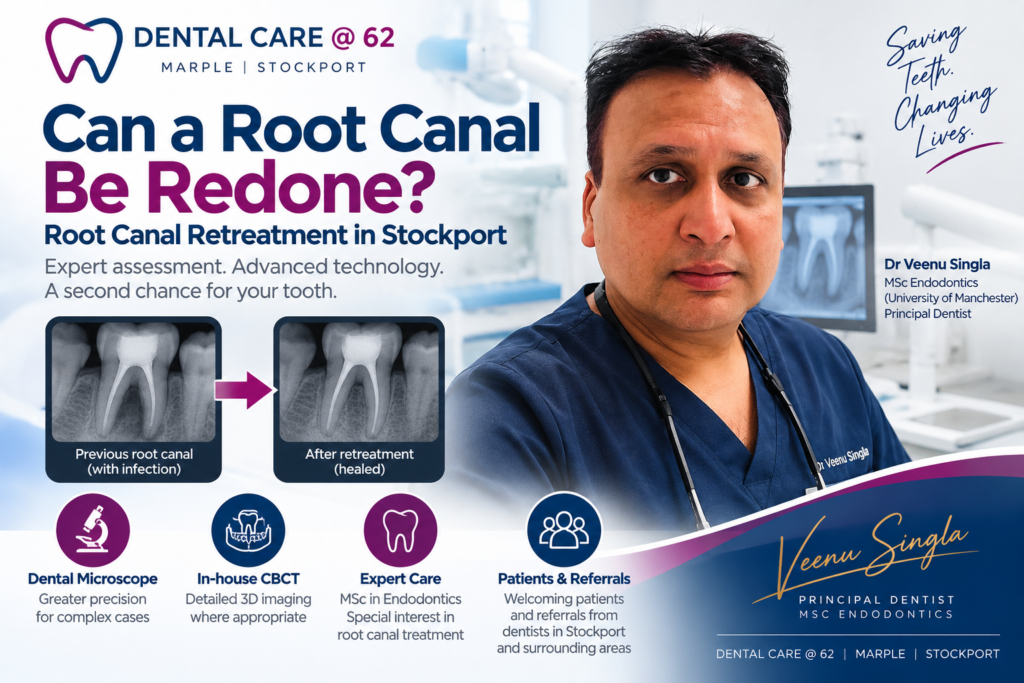
A tooth that has already had root canal treatment can feel worrying when it starts to ache, swell or show signs of infection again. The reassuring answer to the question, can a root canal be redone, is often yes. Root canal retreatment may give a tooth another opportunity to heal and remain in place, although the right option depends on the tooth, the cause of the problem and its long-term restorability.
At Dental Care @ 62 in Marple, we take time to assess these situations carefully. Dr Veenu Singla, Principal Dentist at Dental Care @ 62, holds an MSc in Endodontics from the University of Manchester and has a special interest in root canal treatment, including the assessment and management of more complex cases. A previous root canal treatment has not necessarily “gone wrong” because symptoms have returned years later. Teeth and restorations change over time, and a clear diagnosis is the starting point for any sensible decision.
Why might a root canal need to be redone?
Root canal treatment removes inflamed or infected tissue from inside a tooth, cleans the root canal system and seals it to reduce the chance of bacteria returning. Root canals are very fine and can have complex shapes, branches or curves. Even with careful treatment, it is sometimes difficult to clean every part of that anatomy completely.
In other cases, the original treatment may have settled well, but bacteria have entered the tooth later through a leaking filling, a damaged crown or new decay. A crack in the tooth can also allow bacteria towards the root canal system and may affect whether retreatment is appropriate.
Signs that merit a dental assessment include:
- pain on biting or persistent tenderness around the tooth
- swelling, a gum boil or an unpleasant taste
- a tooth becoming loose or discomfort returning after a long symptom-free period
- a dark area near the root seen on an X-ray during a routine examination
Not every previously treated tooth with an X-ray change causes pain, and not every ache means a root canal has failed. Problems with the bite, gum disease, a cracked tooth or a neighbouring tooth can feel similar. This is why diagnosis matters before treatment is planned.
Can a root canal be redone successfully?
Retreatment can be a worthwhile way to preserve a natural tooth where there is a reasonable chance of healing and the tooth can be restored to function afterwards. It involves reopening the tooth, removing the previous root filling material where possible, cleaning and disinfecting the canals again, then filling and sealing them. A new filling or crown is often needed afterwards to protect the tooth from leakage and fracture.
The outlook varies from one case to another. It may be less favourable if there is a significant crack extending down the root, advanced loss of supporting bone, very limited healthy tooth structure left above the gum, or an infection that cannot be accessed adequately through the tooth. No responsible clinician can promise a particular outcome, but thorough assessment helps identify when retreatment is a proportionate option.
A tooth that is comfortable following retreatment still needs a good long-term seal and regular care. Teeth requiring root canal treatment have often already lost significant tooth structure through decay, cracks, previous restorations or the access required for treatment. Depending on how much healthy tooth structure remains, a crown, onlay or other cuspal-covering restoration may be recommended to help reduce the risk of fracture.
How we assess a failing root canal
A consultation usually begins with a conversation about the tooth, previous treatment, symptoms and your wider dental health. We examine the tooth and surrounding gums, assess how it meets the opposing teeth and take appropriate X-rays.
For more complex cases, CBCT imaging may be useful. This is a three-dimensional scan that can show the roots, surrounding bone and nearby structures in greater detail than a conventional dental X-ray. It is not necessary for every patient, but can be particularly helpful where root anatomy is complex, infection persists, previous treatment needs further assessment or surgical treatment is being considered.
A dental operating microscope can also assist during suitable root canal procedures. At Dental Care @ 62, a dental operating microscope is available for root canal treatment and retreatment where appropriate. Its enhanced magnification and illumination can help with identifying fine or previously untreated canal anatomy, removing previous root filling material and managing technically demanding areas of the tooth. Technology supports clinical judgement, rather than replacing it, and we will explain why any investigation or treatment is being recommended.
What does root canal retreatment involve?
Retreatment is normally carried out under local anaesthetic, with comfort and communication considered throughout. Many patients are relieved to find that the appointment feels more manageable than they expected, particularly when they know what will happen at each stage.
The clinician creates access through the existing restoration or, in some cases, removes a crown or filling. Previous root filling material is carefully removed, and the canals are cleaned using fine instruments and disinfecting solutions. Because a previously treated tooth may be complex, treatment can take more than one appointment. A temporary seal may be placed between visits if needed.
Once the canals are suitably cleaned and dry, they are filled and sealed. The final restoration is an essential part of the plan. Depending on how much healthy tooth remains and where the tooth sits in the mouth, this may be a strong filling, an onlay or a crown. We will discuss the practical advantages, costs and limitations of each option before you decide.
When retreatment may not be the right choice
Saving a natural tooth is often desirable, but it is not always possible or sensible. If a tooth has a vertical root fracture, cannot be predictably restored, or has a poor level of support from the surrounding bone, extraction may be the kinder long-term option.
Sometimes root canal retreatment through the crown of the tooth is not feasible, while a surgical approach around the root tip may be considered. This is known as apical surgery. It is not suitable for every tooth and requires careful planning, but it can be an option in selected cases.
If extraction is necessary, the conversation should not stop there. Replacing the tooth with an implant, bridge or removable denture may be considered, while in some positions leaving a gap may be acceptable. The best choice depends on your bite, neighbouring teeth, gum health, preferences and budget. There is no one-size-fits-all answer.
Complex root canal treatment and referrals in Stockport
Dental Care @ 62 also welcomes referrals from other dentists for assessment of complex root canal cases and previously root-treated teeth.
Dr Veenu Singla holds an MSc in Endodontics from the University of Manchester and has a special interest in endodontic treatment. The practice has access to a dental operating microscope and in-house CBCT imaging where clinically appropriate, helping with the assessment and management of more complex cases.
Following assessment, we can explain whether root canal retreatment, monitoring, apical surgery, extraction or another approach should be considered. Where a patient has been referred by their own dentist, we can communicate our findings and treatment as appropriate with the referring practice.
Is retreatment painful and what is recovery like?
During treatment, local anaesthetic is used to keep you comfortable. Afterwards, the tooth and surrounding area may feel tender for a few days, especially when biting. This can usually be managed with appropriate over-the-counter pain relief if it is safe for you to take it, alongside following the advice given by your dental team.
Contact the practice promptly if swelling develops or worsens, severe pain is not settling, you feel unwell, or a temporary filling breaks. Avoid chewing hard foods on the tooth until its final restoration is in place. If you are anxious about dental treatment, please say so from the outset. We can talk through the process at your pace and plan appointments with your comfort in mind.
Questions to ask before deciding
Before agreeing to redo a root canal, it is reasonable to ask what is thought to have caused the problem, how restorable the tooth is, whether a CBCT scan would add useful information and what restoration will be needed afterwards. You may also want to understand the alternatives, likely time involved and what follow-up will be recommended.
A good treatment plan considers more than the X-ray. It should account for the value of the tooth in your bite, your oral health, the condition of nearby teeth and what matters most to you. In some cases, monitoring is appropriate; in others, acting sooner can limit discomfort and prevent infection from progressing.
Concerned about a previously root-treated tooth?
If a tooth that has already had root canal treatment is painful, tender, swollen or has shown an area of concern on an X-ray, an assessment can help establish why and whether the tooth may still be saved.
Dental Care @ 62 in Marple welcomes patients from Stockport and surrounding areas for root canal retreatment assessments, including more complex cases. We also accept referrals from dentists.
Contact Dental Care @ 62 to arrange an assessment and discuss the options for preserving your tooth.
0 comments on “Can a Root Canal Be Redone? Root Canal Retreatment in Stockport”