
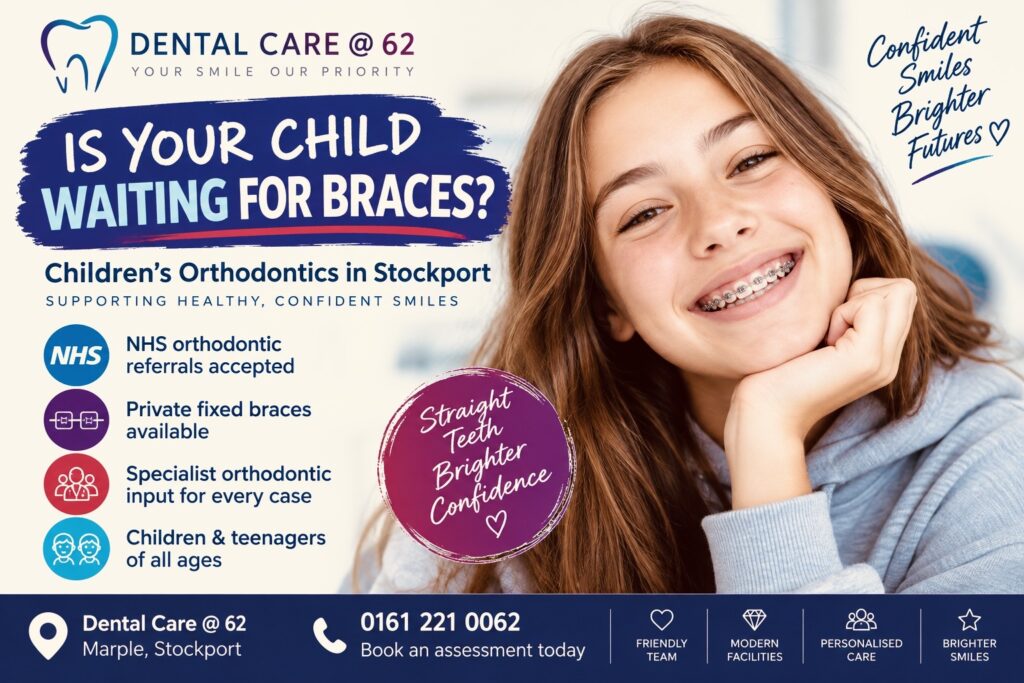
A front tooth that sits behind another, a noticeable gap, or a bite that does not meet comfortably can prompt parents to look into children’s orthodontics in Stockport. The right next step is usually not to assume braces are needed straight away, but to arrange a thoughtful assessment. Children develop at different rates, and timing can make a real difference to which options are appropriate.
At Dental Care @ 62 in Marple, orthodontic care begins with listening to the child and parent, examining how the teeth and jaws are developing, and explaining any findings clearly. Some children benefit from monitoring; others may need treatment while they are still growing. The aim is to recommend an approach that is appropriate for the individual child, not simply to straighten teeth as early as possible.
When should a child have an orthodontic assessment?
An orthodontic assessment can be helpful during childhood if there are concerns about how the teeth or jaws are developing. Some problems can be identified before all of the adult teeth have erupted, although many children will not need active orthodontic treatment until later. This gives the dentist an opportunity to identify developing concerns with tooth position, the bite, jaw growth or the way adult teeth are erupting.
An early check does not commit your child to braces. In many cases, the most sensible plan is to review their development over time. However, earlier assessment can be particularly valuable where there is a crossbite, prominent upper front teeth that may be more vulnerable to injury, a crowded arch, an adult tooth erupting in an unusual position, or a significant difference between the upper and lower jaws.
Parents should also seek advice if a child finds it difficult to bite or chew, regularly bites their cheek or palate, has prolonged thumb or finger sucking habits, or feels self-conscious about their teeth. These signs do not always mean treatment is needed, but they are worth discussing.
Why waiting can sometimes be the better choice
Most comprehensive orthodontic treatment begins when most or all permanent teeth are present, often between the ages of 11 and 14. Treating too early can mean a longer overall process, particularly if further treatment is needed once the remaining adult teeth erupt.
There are exceptions. Certain bite concerns are easier to guide while a child is still growing, and creating space or correcting the position of individual teeth may help avoid complications later. The balance depends on the child’s teeth, jaws, growth pattern, oral health and ability to cooperate with treatment.
What happens at a children’s orthodontics assessment in Stockport?
The first appointment should feel calm and unhurried. The dentist will ask about your child’s dental history, any concerns about their bite or appearance, and their general health. They will look at the teeth, gums, jaws and facial profile, as well as how the upper and lower teeth meet.
Photographs, digital scans and X-rays may be recommended where they will add useful information. X-rays are not taken as a routine extra. They are used when clinically justified, for example to check the position of teeth that have not yet erupted or to assess root development. Where more detailed three-dimensional information is appropriate, in-house CBCT imaging can support careful planning, while keeping radiation exposure and the reason for imaging under close consideration.
Following the assessment, you should understand whether your child needs treatment now, later, or simply monitoring. If treatment is advised, the discussion should cover what it is designed to achieve, the likely timescale, the practical commitments involved and any reasonable alternatives. Parents and children should have time to ask questions before deciding how to proceed.
NHS orthodontic referrals and private treatment in Stockport
Dental Care @ 62 accepts NHS orthodontic referrals for children and young people. Eligibility for NHS orthodontic treatment is determined following clinical assessment and according to NHS criteria. NHS orthodontic treatment is based on clinical need and eligibility criteria, and waiting times can vary.
We understand that some families may already have been referred for NHS orthodontic treatment or may be on an NHS orthodontic waiting list and would prefer to explore whether treatment could begin sooner.
For these families, Dental Care @ 62 also offers a separate private orthodontic pathway, including fixed braces for suitable children and teenagers. Choosing to enquire about private treatment does not mean that treatment is automatically recommended. Your child would first need an orthodontic assessment so that their teeth, bite, dental development and treatment needs can be considered properly.
If private treatment is appropriate, the proposed treatment, expected timescale, fees, benefits, limitations and alternatives will be explained before you decide whether to proceed.
Families do not need to feel pressured into choosing private treatment simply because they are waiting for NHS care. Our role is to explain the available options clearly so parents can make an informed decision for their child.
Specialist orthodontic input in treatment planning
At Dental Care @ 62, children’s orthodontic cases are carefully assessed and treatment planning is carried out with input from Dr Samantha Haque, Specialist Orthodontist (GDC 153034), who works with our clinical team.
This allows treatment decisions to consider not only how straight the front teeth appear, but also the child’s bite, dental development, facial growth and long-term stability.
Fixed braces remain a reliable option for many children and teenagers. Small brackets are attached to the teeth and connected with a wire that is adjusted at planned appointments. Because they remain in place throughout treatment, they can be suitable for more complex tooth movements and do not rely on the child remembering to wear them.
Clear aligners can suit some teenagers, particularly where the planned movements are less complex and the child can wear the aligners for the recommended number of hours each day. They are removable for meals and brushing, which some families find helpful. The trade-off is responsibility: aligners only work as intended when they are worn consistently and kept safe.
In some situations, removable appliances or growth-guidance appliances may be considered. Occasionally, creating enough room for teeth to align may involve removing selected teeth. This is never assumed from the outset. It is considered carefully as part of a full assessment, taking account of the bite, facial balance, tooth size and the long-term position of the teeth.
The most suitable treatment is not necessarily the least visible option. It is the one that offers a sensible balance of clinical benefit, comfort, practicality and predictable cooperation for your child.
The part families play during treatment
Orthodontics is a shared effort. Appointments and careful clinical planning matter, but day-to-day habits have a considerable effect on progress. Children with fixed braces need to brush thoroughly around brackets and along the gumline. A fluoride toothpaste, suitable interdental cleaning aids and regular hygiene advice can help reduce the risk of plaque build-up, swollen gums and permanent marks on teeth.
Hard, sticky and very sugary foods can damage braces or increase the risk of decay. It is usually easier to make a few realistic changes than to create an overly restrictive food list that no one can maintain. For children wearing aligners, the key routines are wearing them as directed, removing them for eating and drinking anything other than water, and storing them safely in their case.
A mouthguard is particularly important for contact sports. Let the dental team know about holidays, school trips or major events so appointments can be planned as smoothly as possible.
Retainers are not an optional afterthought
Once active tooth movement is complete, retainers help hold the teeth in their new positions. Teeth naturally have a tendency to move throughout life, so retention is an important part of protecting the result. Your child will be shown how to use and care for their retainer, and parents can help by building this into the evening routine.
Supporting a nervous child
Children often take their cue from the adults around them. It can help to describe an orthodontic visit simply: the team will look at their teeth, take some pictures or scans if needed, and talk about how their bite is growing. Avoid presenting the appointment as something frightening or as a consequence of not brushing well enough.
A good consultation gives a child a chance to feel involved. They can see the equipment, ask questions and understand what will happen at each stage. If your child is anxious, tell the practice when arranging the appointment. Extra time, clear explanations and an agreed pace can make the experience more manageable.
Common questions from parents
Will my child need braces on the NHS or privately?
Eligibility for NHS orthodontic treatment is based on clinical need and specific assessment criteria. Some children may qualify, while others may not meet the threshold despite having concerns about alignment. Private orthodontic care can provide an alternative route and may offer different appliance choices, but suitability, cost and expected benefits should be discussed openly before treatment starts.
How long do children’s braces take?
Active treatment often takes between 12 and 24 months, but this varies considerably. The complexity of the bite, the type of appliance, how teeth respond and attendance at appointments can all affect the timeframe. A personalised estimate is more meaningful after a proper examination.
Can orthodontic treatment damage teeth?
When treatment is carefully planned and oral hygiene is maintained, orthodontics can be carried out safely. The main avoidable risks are decay, gum inflammation and white marks on the enamel caused by plaque around appliances. Regular brushing, dietary care and attendance are therefore central to treatment, not minor details.
Is your child waiting for NHS orthodontic treatment?
Dental Care @ 62 in Marple accepts NHS orthodontic referrals and also provides private orthodontic treatment for children and teenagers, including fixed braces.
If your child is currently on an NHS orthodontic waiting list and you would like to explore a private treatment option, contact our team to arrange an assessment. We can explain whether treatment is appropriate, the options available and the likely costs and timescale before you make any decision.
Contact Dental Care @ 62 on 0161 221 0062 to discuss your child’s orthodontic care.
One comment for “Children’s Orthodontics in Stockport: NHS Referrals, Private Braces & When to Start”
NHS Versus Private Dental Care Explained – Dental Care @ 62
[…] the threshold. Private orthodontic care can provide an alternative for families who want to explore fixed braces or clear aligners, provided the treatment is […]