
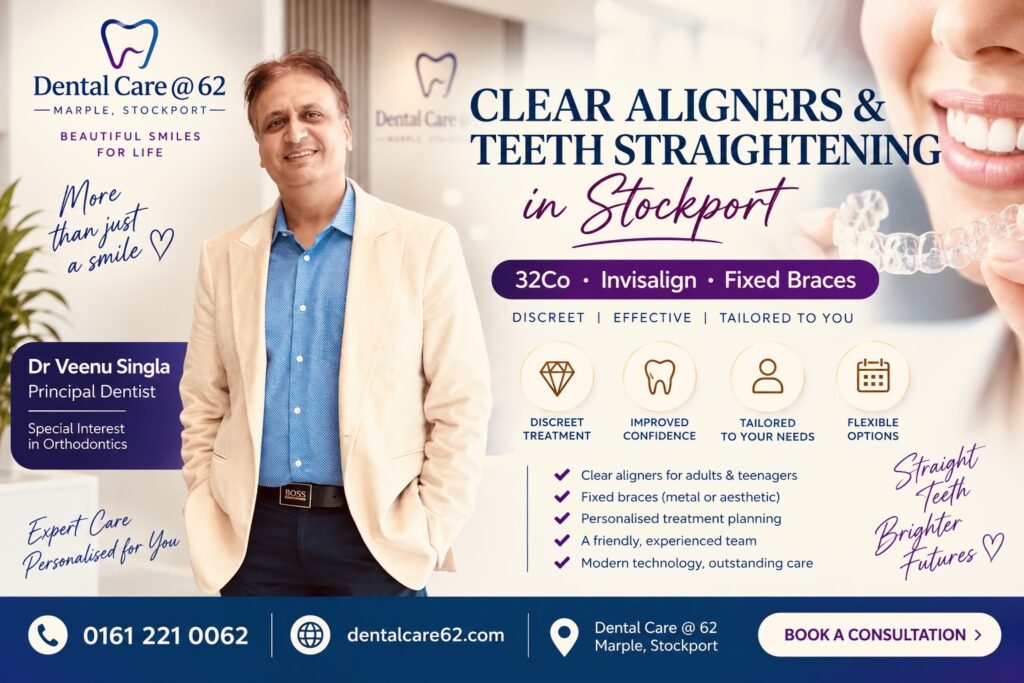
A photograph, an upcoming wedding or simply feeling more confident when smiling can prompt people to consider teeth straightening. If you are looking for clear aligners in Stockport, you may come across different systems and brand names, including Invisalign and 32Co.
Invisalign is one well-known brand of clear aligner, but it is not the only clear aligner system available. At Dental Care @ 62 in Marple, we offer clear aligner treatment including 32Co, and Invisalign can also be considered where appropriate. The important question is not simply which brand to choose, but which orthodontic approach is most suitable for your teeth, bite, lifestyle and treatment goals.
What does treatment involve?
Invisalign or 32Co – what’s the difference?
Invisalign and 32Co are different clear aligner systems designed to move teeth using a planned sequence of removable aligners. While patients may recognise the Invisalign name more readily, the brand itself should not determine whether clear aligner treatment is appropriate.
At Dental Care @ 62, 32Co is one of the clear aligner systems we provide, and Invisalign treatment can also be considered for patients who prefer that system or where it is clinically appropriate.
The choice should be based on factors such as the tooth movements required, the complexity of the bite, treatment objectives and the individual patient’s circumstances. During your consultation, we can explain the suitable options rather than assuming that one particular aligner brand is right for everyone.
Clear aligners in Stockport: what can they treat?
Clear aligners move teeth gradually through a planned series of trays. Each aligner is worn for most of the day before progressing to the next in the sequence. They may be suitable for concerns such as mild to moderate crowding, gaps between teeth, teeth that have moved since previous orthodontic treatment, and selected bite problems.
The important word is “selected”. Tooth movement is influenced by the shape and position of the roots, the health of the gums and supporting bone, the way the upper and lower teeth meet, and the amount of movement required. A front tooth may look slightly out of line, for example, but the most appropriate treatment can only be decided after looking at the whole bite.
Before clear aligner treatment, your dentist will examine your teeth and gums and discuss your aims. Photographs, digital scans and, where required, X-rays allow treatment to be planned accurately. Advanced imaging may be useful in particular situations, although it is not necessary for every orthodontic assessment. Any decay, active gum disease or urgent dental problem should be addressed before teeth are moved.
What does treatment involve?
Following assessment, a digital treatment plan is created to show the intended stages of tooth movement. This gives a useful preview of the proposed outcome, but it is still a clinical plan rather than a guarantee. Teeth do not always move exactly as predicted, so reviews and refinements are sometimes needed to achieve an appropriate result.
Your custom aligners are usually changed at intervals advised by your dentist. To work effectively, they need to be worn consistently, commonly around 20 to 22 hours each day. They should be removed for meals and drinks other than water, then cleaned before being placed back in the mouth.
Many cases also require small, tooth-coloured attachments. These are bonded temporarily to selected teeth and give the aligners more purchase for controlled movements. Some patients may need very small amounts of enamel shaping between certain teeth to create space. This is carefully assessed and explained in advance, including why it is recommended and what it involves.
Appointments during treatment allow your progress, gum health and bite to be checked. Treatment length varies considerably. Straightforward alignment may take several months, while more involved movements can take longer. The number of trays alone does not tell the full story, as the complexity of the bite and the body’s response to tooth movement also matter.
When might fixed braces be a better choice?
Clear aligners offer discretion and can be removed for eating and brushing, which many people value. However, their success relies on wearing them as directed. If you think keeping aligners in for most of the day will be difficult because of work, school, frequent snacking or forgetfulness, fixed braces may be more predictable.
Fixed braces can also be preferable for some complex tooth movements and bite corrections. They are not a lesser option. Modern fixed braces are a well-established orthodontic treatment, and for the right case they may offer the most controlled route to a healthy, stable result.
In some situations, no orthodontic treatment may be the most sensible decision. If the concern is mainly cosmetic and the tooth positions are otherwise stable, it is worth discussing the benefits, limitations and long-term commitment before proceeding. Good treatment planning is about choosing the appropriate option, not simply the least visible one.
Everyday care with clear aligners
Clear aligners should fit snugly and feel firm when a new tray is first worn. A sense of pressure is common as teeth begin to move, particularly for the first day or two after changing aligners. Significant discomfort, a tray that will not fit, a broken attachment or an aligner that has been lost should be reported promptly so that you can receive the right advice.
Good oral hygiene becomes even more important during orthodontic treatment. Brush twice daily with fluoride toothpaste, clean between your teeth every day and attend routine dental appointments as advised. Food and sugary drinks can become trapped beneath an aligner, increasing the risk of decay if teeth are not cleaned properly.
A few simple habits make treatment easier: keep aligners in their protective case whenever they are out of your mouth, rinse them in cool water, and avoid hot water, which can distort the plastic. Do not wrap them in a tissue – this is a common way for aligners to be accidentally thrown away.
Retainers protect the result
Teeth can continue to move throughout life, whether or not you have had orthodontic treatment. Retainers are therefore an essential part of clear aligner treatment, rather than an optional extra at the end.
Your dentist will advise whether removable retainers, a bonded wire retainer behind the front teeth, or a combination of both is appropriate. Your clinician will give you individual instructions about how and when to wear your retainers. Long-term retainer wear is usually required to help maintain the position of the teeth. A bonded retainer can be helpful, but it still needs regular checks and careful cleaning, and it does not always hold every tooth in position.
Planning for retention from the beginning supports the time, commitment and cost you have invested in treatment. It also provides an opportunity to discuss any future restorative work, such as replacing old fillings or improving worn teeth, once the teeth are in their planned positions.
Choosing clear aligners with confidence
Dr Veenu Singla, Principal Dentist at Dental Care @ 62, has a special interest in orthodontics and provides both clear aligner and fixed-brace treatment. Having different orthodontic options available means treatment can be considered according to the individual clinical situation rather than being limited to one type of appliance.
A worthwhile consultation should leave you with a clear understanding of what can realistically be achieved. Ask how your bite will be assessed, how often you will be reviewed, whether attachments or enamel shaping are likely, and what happens if additional aligners are needed. You should also understand the commitment to retainers and the fees involved before treatment begins.
For nervous patients, orthodontic care should not feel rushed or intimidating. It is entirely reasonable to ask questions, take time to consider the options and explain any previous difficult dental experiences. A calm, non-judgemental conversation can make the process feel much more manageable.
Can I eat while wearing clear aligners?
It is usually best to remove aligners before eating. This helps prevent staining, damage and food becoming trapped against the teeth. Water is generally fine to drink while wearing them, but sugary, acidic or hot drinks should be avoided unless the aligners are removed.
Are clear aligners suitable for teenagers?
They can be suitable for some teenagers, provided they are able to wear them consistently and look after them. The right choice depends on the individual’s developing teeth, bite, motivation and orthodontic needs. Parents and teenagers should be involved in the discussion so expectations are clear.
Will I need to wear a retainer forever?
Long-term retainer wear is usually advised because teeth naturally have a tendency to move over time. Your clinician will give you individual instructions about how and when to wear your retainers, depending on your treatment and circumstances.
At Dental Care @ 62 in Marple, Stockport, we provide clear aligner and fixed-brace treatment with careful assessment and individual treatment planning. Whether you are considering 32Co, Invisalign, clear aligners generally or fixed braces, a consultation can help you understand which options are appropriate for your teeth and bite.
Contact Dental Care @ 62 to arrange a teeth-straightening consultation and discuss the options available to you.
0 comments on “Clear Aligners in Stockport: Invisalign, 32Co or Fixed Braces – Which Is Right for You?”