
A tooth that starts to ache, a child who needs their first check-up, or a crown that has finally failed can make the question of NHS versus private dental care feel urgent. The right route is not simply about paying more or less. It depends on the treatment you need, how quickly you need to be seen, the options that matter to you and what is clinically appropriate for your long-term oral health.
Both NHS and private dentistry can provide valuable care. Understanding the differences can help you make an informed decision without pressure or confusion.
NHS versus private dental care: the main difference
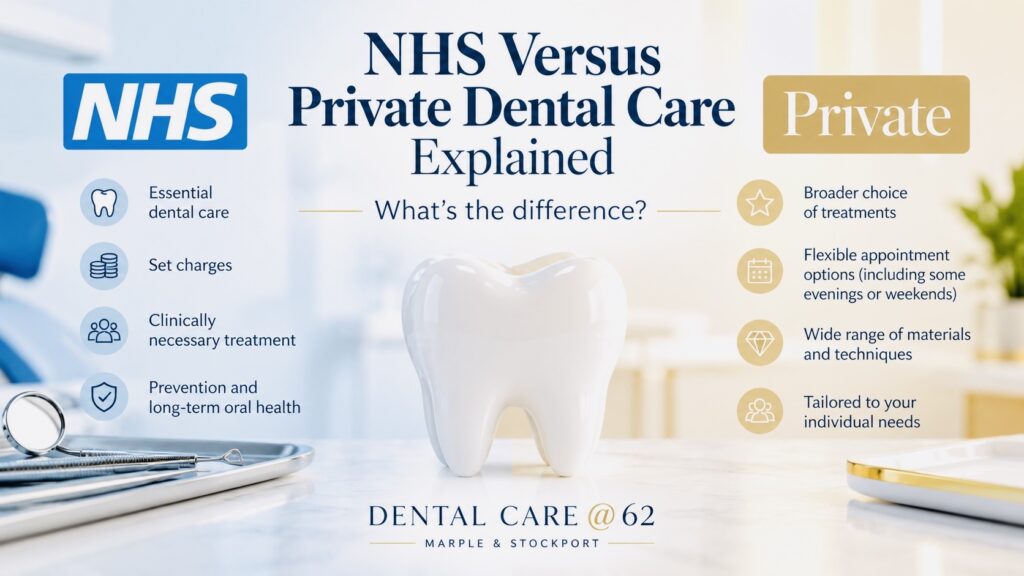
NHS dental treatment is designed to keep your mouth, teeth and gums healthy. In England, it covers examinations, diagnosis and treatment that your dentist considers clinically necessary to secure and maintain oral health. Charges are set nationally and are grouped into treatment bands, although exemptions may apply for some patients, including eligible children and those on certain benefits.
Private dental care is paid for directly by the patient. It allows a practice to offer a broader choice of appointment times, materials, treatment approaches and aesthetic options. Fees vary according to the complexity of treatment, the time involved, the skill and equipment required, and the laboratory work needed.
Neither route should mean compromising on professional standards. A responsible dentist will recommend treatment because it is appropriate for you, explain alternatives clearly and respect your decision. The practical differences usually lie in availability, choice and the range of options that can be offered.
What NHS dental care usually covers
NHS dentistry focuses on prevention and necessary treatment. This may include examinations, X-rays where clinically needed, scale and polish treatment when required for gum health, fillings, root canal treatment, extractions, dentures, crowns and urgent care.
However, the NHS does not generally cover treatment provided purely to improve appearance where there is no clinical need. For example, tooth whitening and cosmetic orthodontics are private treatments. If a tooth needs a crown, an NHS crown may be available where clinically indicated, but the material and laboratory options are more limited than those often available privately.
NHS orthodontic treatment for children is assessed against strict clinical criteria. A child with a significant bite problem may qualify, but mild crowding or treatment requested mainly for appearance may not meet the threshold. Private orthodontic care can provide an alternative for families who want to explore fixed braces or clear aligners, provided the treatment is suitable.
Access is another important consideration. NHS appointment availability can be limited, particularly for new patients and non-urgent care. This is often a question of capacity rather than a reflection of the quality of care.
What private dental care can offer
Private dental care can provide additional treatment choices and greater flexibility in how some treatments are planned. At Dental Care @ 62, we aim to see all our patients as promptly as possible, whether they are receiving NHS or private care. Where appropriate, additional private appointments may also be available outside our usual opening hours, including some evenings or weekends.
Private treatment may also offer more choices in materials and techniques. A front-tooth filling, for instance, may be planned with particular attention to shade, shape and translucency. Crowns, bridges and dentures can often be tailored more closely to the appearance and function you are hoping to achieve.
For complex dental problems, private care may make advanced assessment and treatment options more accessible. CBCT imaging creates a detailed three-dimensional view of relevant areas of the jaw, teeth and surrounding structures. Dental microscopy can help clinicians work with greater magnification and illumination during suitable root canal procedures. These tools do not replace careful clinical judgement, but they can support planning in appropriate cases.
Private dentistry may also be helpful where continuity is particularly important. Seeing the same clinician over time can make it easier to build trust, follow a treatment plan and monitor changes in your oral health.
Cost: looking beyond the first appointment
NHS charges can be more predictable because they are set within national bands. If your care falls within a single course of NHS treatment, you usually pay one band charge rather than paying separately for each individual procedure. The current charges can change, so it is sensible to ask the practice for the latest information before treatment begins.
As of 1 April 2026, NHS dental charges in England are:
- Band 1 – £27.90
- Band 2 – £76.60
- Band 3 – £332.10
- Unscheduled urgent care – £27.90
These charges are correct at the time of publication (October 2026) and may change. You can check the latest NHS dental charges on the NHS website.
Private fees are usually itemised. This can feel less straightforward initially, but it also allows treatment to be planned around your individual needs and preferences. You should receive a written estimate before proceeding, with an explanation of what is included and whether there are alternatives at different price points.
The least expensive option is not always the most economical over time, and the highest-priced option is not automatically the right one. The useful questions are whether the treatment is necessary, what it is intended to achieve, how long it may reasonably be expected to last with good care, and what the alternatives involve.
If treatment is extensive, ask whether it can be phased. Addressing pain, infection or active gum disease first may be clinically sensible, while allowing time to plan restorative or cosmetic work later.
Choice and clinical suitability are not the same thing
Private care can offer more options, but more options do not always mean more treatment is needed. An ethical dentist should not recommend replacing a stable filling simply because a more aesthetic alternative exists, nor suggest treatment that is unlikely to offer a meaningful benefit.
Equally, preserving a natural tooth is often worth considering before moving to extraction and replacement. A heavily damaged tooth may sometimes be restored with root canal treatment and a crown, while in other situations extraction is the more predictable option. The answer depends on the remaining tooth structure, gum and bone health, infection, bite forces and your wider dental history.
A good consultation should leave you clear about the benefits, limitations, risks and likely maintenance needs of each approach. If you have had previous unsuccessful treatment or have been told a tooth cannot be saved, it can be reasonable to ask for a fuller assessment before making a final decision.
Urgent appointments, children and anxious patients
If you have severe toothache, swelling, trauma, uncontrolled bleeding or a broken tooth, contact a dental practice promptly. Urgent care aims to relieve pain, manage infection and prevent the problem from worsening. The immediate appointment may focus on stabilising the situation, with definitive treatment arranged once the cause has been properly assessed.
For children, regular dental visits help establish positive habits and identify concerns early. NHS care remains an important route for children, particularly where treatment is clinically necessary. Private care may be chosen by parents who want additional flexibility, private orthodontic assessment or a wider range of appointment options.
Anxious patients can access compassionate care in either setting. Let the team know about past experiences, fears or anything that makes appointments difficult. Simple measures such as clear explanations, agreed stop signals, shorter visits and taking treatment step by step can make a real difference. Choosing a practice where you feel listened to matters as much as choosing a funding route.
Can you combine NHS and private treatment?
In some circumstances, NHS and private dental treatment can form part of the same overall treatment plan. Your dentist should clearly explain which treatment is being provided under the NHS, which options are private, and the costs involved before treatment begins.
You should not feel pressured to choose private treatment where clinically necessary care is available under the NHS. However, you may choose a private option where this is appropriate and has been clearly discussed with you.
The arrangements can vary depending on the treatment. Orthodontic treatment, for example, must be provided as either NHS or private treatment rather than mixing the two within the same orthodontic course of treatment.
If you are unsure, ask for a written treatment plan showing exactly which elements are NHS and which are private.
How to decide what is right for you
Start with your immediate need. If you are in pain, have swelling or are worried about a broken or failing tooth, seek an assessment rather than delaying because you are unsure which route to choose. Once the problem has been diagnosed, it is easier to weigh up your options.
Consider whether your priority is essential treatment at NHS charges, greater appointment flexibility, a particular material or appearance, access to advanced treatment planning, or a longer-term relationship with a clinician who knows your history. There is no single right answer for every patient.
At Dental Care @ 62 in Marple, patients are encouraged to ask questions and take the time they need to understand their choices. Whether you are looking for routine care, help with a dental concern or advice about a more complex problem, arranging a consultation can give you a clear, personal starting point.
0 comments on “NHS Versus Private Dental Care Explained”