
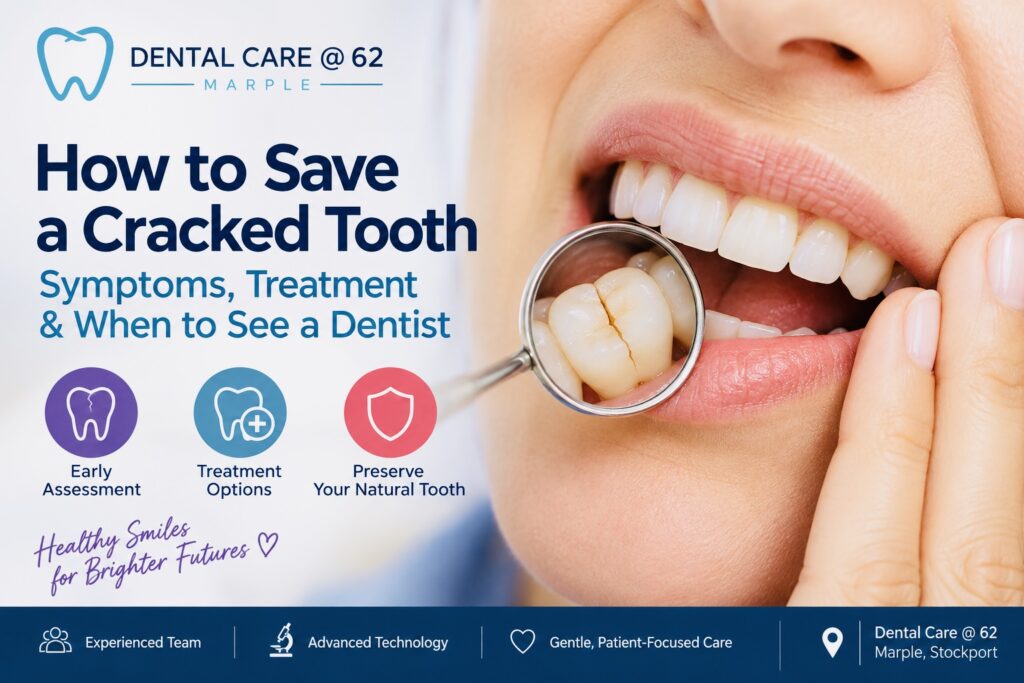
A crack in a tooth can feel alarming, particularly if it happens while eating or is followed by a sharp pain when you bite. If you are wondering how to save a cracked tooth, the most useful first step is to protect it from further force and arrange a dental assessment promptly. Many cracked teeth can be preserved, but the right treatment depends on where the crack is, how deep it extends and whether the inner nerve tissue has been affected.
A crack will not heal by itself in the way a broken bone can. Leaving it may allow the crack to deepen, making the tooth more difficult to restore or, in some cases, impossible to retain. Early assessment gives the best opportunity to keep as much healthy natural tooth tissue as possible.
What to do straight away if you think a tooth is cracked
Avoid chewing on that side of your mouth, even if the discomfort settles. Hard foods, crusty bread, nuts, ice and chewy sweets can place pressure on the crack and cause a larger piece of tooth to break away. Choose softer foods and try to chew on the other side until you have been seen.
Keep the area clean by brushing gently with a soft toothbrush and rinsing with warm salt water if the gum feels sore. If a sharp edge is rubbing your tongue or cheek, a small piece of sugar-free chewing gum or temporary dental wax may provide short-term protection. Do not use household glue or attempt to stick a broken piece back yourself.
Over-the-counter pain relief may help if it is suitable for you and taken according to the packet instructions. However, pain relief does not address the crack itself. Book an urgent dental appointment, especially if pain is persistent, worsens on biting or the tooth has changed colour.
If the tooth has suffered a significant blow, or you have facial swelling, uncontrolled bleeding, fever, difficulty swallowing or trouble breathing, seek urgent medical advice without delay.
Why cracked teeth need prompt assessment
Teeth are strong but not indestructible. A crack may begin in the outer enamel, then extend into the dentine beneath. Dentine contains tiny channels leading towards the pulp, the soft tissue at the centre of the tooth. As a crack deepens, biting forces can flex the tooth and irritate or expose this tissue.
This is why a cracked tooth may cause a sudden, difficult-to-pinpoint pain when biting down or when releasing your bite. It may also be sensitive to hot, cold or sweet foods. Some cracks cause very little discomfort initially, so a tooth that feels mostly normal should not be dismissed after a visible chip or a suspected fracture.
The aim is not simply to cover what can be seen. Your dentist needs to establish whether the crack is superficial, whether the tooth is structurally weakened and whether the nerve or root is involved. Treatment can then be planned around preserving the tooth wherever this is clinically appropriate.
How dentists save a cracked tooth
Your dentist will ask how the problem started, whether you have pain on biting and whether the tooth has had previous fillings, root canal treatment or trauma. They will examine the tooth carefully, often using magnification, bite tests and X-rays. Cracks themselves do not always show on a conventional X-ray, but imaging can reveal changes around the root, decay, old restorations or other factors affecting treatment.
Cracked teeth can sometimes be difficult to diagnose. Assessment may include magnification, bite testing, periodontal probing and dental X-rays. The crack itself may not always be visible on a conventional X-ray. In selected complex cases, CBCT imaging may provide additional information about the tooth, roots and surrounding bone, while a dental operating microscope can assist with detailed assessment and treatment where appropriate.
Small cracks and fractured cusps
A minor enamel crack may need no active treatment beyond monitoring, particularly if there is no pain or weakness. Your dentist may smooth a rough edge or discuss a protective restoration if the tooth is at risk of chipping further.
When a cusp, the pointed part of a back tooth, has fractured, the remaining tooth can often be restored with a filling, onlay or crown. The choice depends on how much healthy tooth remains and how much biting force the tooth needs to withstand. A well-designed onlay can protect the damaged area while preserving more natural tooth structure than a full crown in appropriate cases.
Cracks affecting the nerve
If bacteria or inflammation have reached the pulp, root canal treatment may be needed before the tooth can be protected with a strong restoration. Root canal treatment removes inflamed or infected tissue from inside the tooth, cleans and seals the root canal system, and helps retain the tooth rather than removing it.
Afterwards, a crown or onlay is often recommended for heavily cracked back teeth. This is because the restoration needs to hold the remaining tooth structure together and reduce the risk of the crack spreading under normal chewing forces. The exact approach varies: a front tooth may require a different restoration from a molar, and not every root-treated tooth automatically needs a crown.
When a tooth cannot be saved
Some cracked teeth cannot be predictably restored. A split tooth, certain vertical root fractures, or a crack associated with extensive structural or periodontal damage may have a poor prognosis. However, the position and extent of the crack, the condition of the pulp and supporting tissues, and how much sound tooth remains all influence whether treatment is possible. Your dentist will assess these factors before recommending whether the tooth can reasonably be preserved or whether extraction should be considered.
This can be disappointing, but removing an unsalvageable tooth may prevent recurrent infection and ongoing pain. Ethical treatment planning means being open about both the possibilities and the limitations, rather than promising that every tooth can be saved.
Signs you should seek urgent dental care
Contact a dentist promptly if a cracked tooth causes severe or increasing pain, swelling, a bad taste, fever, or pain that wakes you at night. These can indicate significant inflammation or infection. A tooth that feels loose, has a large missing section, or hurts every time you bite also needs timely assessment.
A crack following an accident should be checked even if there is no immediate pain. Teeth can develop symptoms days or weeks after trauma. For children, a fall or knock to a front tooth deserves particular attention, as early advice can make a meaningful difference to the tooth’s future care.
Can you prevent a cracked tooth from getting worse?
Until your appointment, avoid testing the tooth repeatedly by biting hard to see whether it still hurts. This is understandable, but it can aggravate the problem. Avoid very hot and cold foods if they trigger sensitivity, and do not delay because the pain comes and goes.
In the longer term, treatment for tooth grinding or clenching may help protect vulnerable teeth. Many people clench during sleep without realising it. A custom-made night guard can reduce the damaging forces on teeth for suitable patients, although it will not repair an existing crack. Replacing a failing large filling, managing decay early and avoiding biting hard objects can also reduce the likelihood of further fractures.
A calm, individual approach to treatment
A cracked tooth does not always mean losing it. The earlier it is assessed, the more treatment options may be available, from a conservative restoration to root canal treatment and protective coverage. If you are anxious about dental treatment, tell the team from the outset. A calm explanation of what is happening, what each option involves and what can be done to support your comfort can make the situation more manageable.
At Dental Care @ 62 in Marple, Stockport, we assess cracked and damaged teeth carefully before recommending treatment. Dr Veenu Singla, Principal Dentist, holds an MSc in Endodontics from the University of Manchester and has a special interest in root canal treatment. Our practice also has a dental operating microscope and in-house CBCT imaging, which may be used in selected cases where clinically appropriate.
If you have pain when biting, suspect that a tooth has cracked, or have broken part of a tooth, arrange an assessment promptly. Where the tooth has a reasonable prognosis, our priority is to consider appropriate options for preserving the natural tooth rather than assuming it needs to be removed.
2 comments on “How to Save a Cracked Tooth: Symptoms, Treatment & When to See a Dentist”
Emergency Dentist Marple & Manchester | Dental Care @ 62
[…] cracked tooth during lunch, a child who has fallen and damaged a front tooth, or a swelling that has appeared […]
Tooth Sensitivity Causes | Dental Care @ 62
[…] A crack can be difficult to see and may cause a sudden pain when biting or when releasing the bite. Teeth can crack after biting hard foods, through injury, or as a result of repeated clenching and grinding. Small chips can also expose sensitive areas. […]