
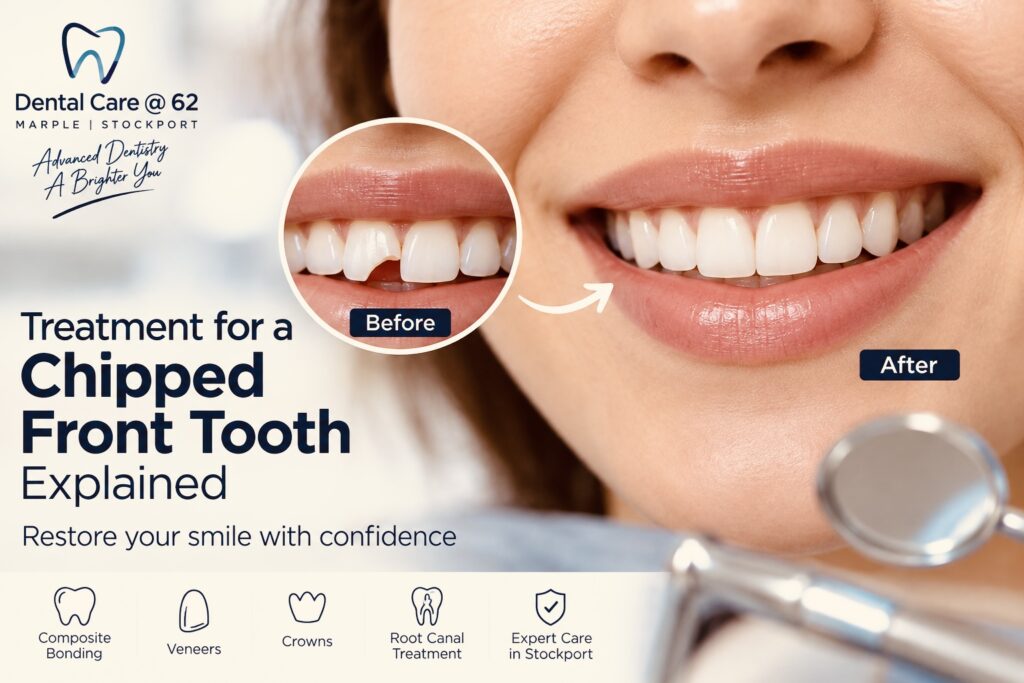
A chipped front tooth can feel alarming, particularly when it changes your smile straight away. The right treatment for a chipped front tooth depends on how much tooth has broken away, whether the deeper layers of the tooth have been affected, and the condition of the surrounding teeth. In many cases, a chip can be repaired conservatively. However, prompt assessment is sensible, especially after an accident or if the tooth is painful, sensitive, loose or displaced.
At Dental Care @ 62 in Marple, Stockport, we assess the whole tooth before recommending treatment. This includes considering the extent of the damage, the appearance of the repair, how the teeth bite together and the long-term health of the tooth — rather than simply covering the visible damage.
When a chipped front tooth needs urgent care
A small, smooth chip is not always a dental emergency, but it should still be checked. Even a minor fracture can leave an edge that catches the tongue or lip, and a tooth may have suffered a deeper crack that is not obvious at first.
Arrange an urgent dental appointment if the tooth is painful, very sensitive to hot or cold, bleeding, loose, noticeably displaced, or has developed a visible pink or red tissue within the fracture, or if the tooth subsequently becomes darker in colour. These signs may indicate damage closer to the pulp, the soft tissue inside the tooth containing its nerve and blood supply. A chip following a fall, sports injury or blow to the face also deserves assessment, even if you feel well.
If possible, keep any broken piece of tooth. If you can find the broken fragment, keep it moist and bring it with you to the appointment. Milk can be used for temporary storage. In some cases, the original fragment may be suitable for reattachment. Occasionally, it may be possible to bond the original fragment back into place. Avoid biting on the affected tooth until you have been seen.
Treatment for a chipped front tooth: the main options
The most appropriate option will depend on the size and position of the chip, your bite, tooth colour, oral health and your own priorities. A natural-looking result matters, but preserving healthy tooth structure wherever appropriate matters too.
At Dental Care @ 62, Dr Veenu Singla, Principal Dentist, has a particular interest in restorative and aesthetic dentistry as well as endodontics. Treatment is planned with an emphasis on preserving healthy tooth tissue wherever appropriate while restoring function and appearance.
Smoothing or reshaping a very small chip
Where only a tiny corner or rough edge has broken, the tooth can sometimes be gently polished and reshaped. This is usually the most conservative approach, as it involves removing very little additional enamel. It may not be suitable where smoothing would make the tooth look uneven or affect the way your teeth meet.
Composite bonding
Composite bonding is commonly used for small to moderate chips. The dentist carefully matches a tooth-coloured resin to the shade of your enamel, then layers, shapes and polishes it to restore the missing area. Often, little or no drilling is required.
Bonding can produce a subtle and effective repair, particularly for a single chipped edge. It is not indestructible, however. Composite can stain, wear or chip over time, especially for people who bite their nails, chew pens, grind their teeth or regularly bite into hard foods with their front teeth. Repairs and maintenance may be needed in future.
A veneer for more extensive cosmetic change
A veneer is a thin facing made from porcelain or composite that covers the front surface of a tooth. It may be considered when the chip is more substantial, when the tooth also has discolouration or shape concerns, or when a bonded repair alone is unlikely to give the desired result.
Porcelain veneers can be highly colour-stable and hard-wearing, but they usually require some preparation of the tooth. This is a significant consideration because enamel does not grow back. Veneers are therefore planned carefully and are not automatically the first choice for every chipped tooth, particularly in younger patients or where a simple repair would be sufficient.
A crown when the tooth is significantly weakened
A crown covers the whole visible part of the tooth and may be recommended if a large amount of structure has been lost, the tooth has multiple cracks, or an older filling has failed. It can protect a weakened tooth and restore its appearance and function.
Because crown treatment involves shaping the tooth, it is generally reserved for situations where a less invasive repair is unlikely to provide reliable support. Your dentist should explain why a crown is being considered, what alternatives exist, and how it may affect the tooth over time.
Root canal treatment and restoration
If the pulp has been exposed or damaged by the fracture, treatment will depend on the extent of the injury, symptoms, pulp health and the age and development of the tooth. In some cases, treatment aimed at preserving pulp vitality may be appropriate; in others, root canal treatment may eventually be required if the pulp becomes irreversibly inflamed or infected. Symptoms can include persistent pain, prolonged sensitivity, swelling, or a tooth that gradually darkens after an injury.
Root canal treatment removes inflamed or infected tissue from inside the tooth, cleans and seals the root canal system, then allows the tooth to be restored. Front teeth can sometimes be restored with bonding, while more heavily damaged teeth may need additional protection. Dental X-rays are usually the first-line imaging where indicated. In selected complex cases, additional assessment such as CBCT imaging may be considered where clinically justified. Dental microscopy can also assist with examination and treatment in appropriate cases.
Why the bite matters as much as the chip
A repair that looks excellent on the day can fail early if it is placed under excessive biting pressure. This is particularly relevant when front teeth meet edge-to-edge, when a tooth has moved position, or when someone clenches or grinds their teeth.
Your dentist will assess how your teeth contact when you bite and move your jaw. In some circumstances, orthodontic treatment may be part of the longer-term plan if tooth position is contributing to repeated chipping. For people who grind at night, a custom-made protective appliance may also be discussed once the tooth has been repaired.
This careful planning is one reason there is no single answer to a chipped front tooth. Two chips that look similar in a photograph may need very different treatment after a clinical examination.
What happens at a dental assessment?
When you attend for assessment and treatment for a chipped front tooth, the appointment will normally begin with a conversation about how and when the chip happened, any symptoms, and what concerns you most. The appointment will normally begin with a conversation about how and when the chip happened, any symptoms, and what concerns you most. Your dentist will examine the tooth, nearby teeth, gums and bite. X-rays may be advised if there is a possibility of a deeper fracture, root damage or injury to the nerve.
You should be given clear information about the suitable options, including likely maintenance, limitations and costs where relevant. If you feel nervous about dental treatment, let the team know. A calm, unhurried approach and a chance to ask questions can make a real difference, particularly after an unexpected accident.
For children, preserving as much natural tooth tissue as possible is usually a central consideration. A child who has injured a front tooth should be assessed even if the chip seems small. Dental trauma in children requires careful assessment because treatment and follow-up depend on whether the injured tooth is a baby or permanent tooth and, for permanent teeth, its stage of development.
Looking after a repaired front tooth
A repaired tooth benefits from the same daily care as your natural teeth: brushing twice a day with fluoride toothpaste, cleaning between the teeth, and attending regular dental reviews. For the first day or two after a repair, it can be wise to avoid biting hard foods directly with the treated tooth.
xIf you play contact sport, a professionally made mouthguard can help reduce the risk of future dental injuries. Avoid using teeth to open packaging or bottles, and consider discussing teeth grinding if you regularly wake with jaw tension, headaches or worn teeth.
If a composite repair chips again, do not be discouraged. This does not necessarily mean the original treatment was wrong. It may indicate a change in bite forces, habits or the condition of the underlying tooth, all of which can be reviewed.
The right treatment for a chipped front tooth can often restore both appearance and function while preserving as much healthy tooth tissue as possible. Early assessment can also identify deeper damage that may not be immediately visible.
0 comments on “Treatment for a Chipped Front Tooth: Bonding, Veneers, Crowns & More”