
A missing tooth can affect far more than the appearance of your smile. It may make chewing less comfortable, alter speech, allow neighbouring teeth to drift, or leave you feeling self-conscious when you laugh or talk. There are several options for replacing missing teeth, and the right choice depends on the tooth involved, the health of your gums and remaining teeth, your bite, and what matters most to you.
At Dental Care @ 62 in Marple, Stockport, we assess missing teeth individually and discuss suitable options, which may include dentures, conventional or resin-bonded bridges, and dental implants. In some situations, leaving a space may also be a reasonable option.
For some people, replacing a tooth is straightforward. For others, particularly where there has been previous dental treatment, gum disease, bone loss or several missing teeth, careful planning is needed. A good discussion should cover the benefits, limitations, likely maintenance and alternatives for each option, so you can decide with confidence.
Do all missing teeth need replacing?
Not always. A missing wisdom tooth, for example, often does not need to be replaced. In some cases, a gap at the very back of the mouth may have little effect on function. However, a missing front tooth or a tooth used heavily for chewing is more likely to cause practical or cosmetic concerns.
Leaving a gap can sometimes lead to changes over time. Teeth on either side may lean into the space, the opposing tooth can over-erupt, and chewing forces may be placed unevenly on the teeth that remain. These changes do not happen in every case, but they are worth considering when deciding whether treatment is appropriate.
Before discussing replacement, your dentist will also consider whether a damaged tooth can be retained. Where a tooth has a reasonable prognosis and can be predictably restored, preserving the natural tooth may be considered before extraction and replacement. If a tooth cannot be saved, planning for replacement can begin before or after it is removed.
The main options for replacing missing teeth
A removable partial or full denture
A denture is a removable appliance that replaces one, several or all missing teeth. A partial denture usually has replacement teeth attached to a gum-coloured base, sometimes with clasps that help it sit securely around remaining teeth. Full dentures replace a complete arch of teeth.
Dentures can be a sensible option where several teeth are missing, where surgery is not suitable, or where a patient would prefer not to have a fixed restoration. They can also be used as an interim solution while gums and bone heal after extractions.
The trade-off is that dentures take time to get used to. They can move slightly during eating or speaking, particularly when they are new, and they need to be removed for cleaning. Their fit can change as the shape of the jaw changes over time, so adjustments, relines or replacement may eventually be needed. A well-designed denture should be planned around comfort, appearance and the health of the remaining teeth, rather than treated as a one-size-fits-all solution.
A conventional dental bridge
A conventional bridge replaces a missing tooth by using one or more neighbouring teeth as supports. These supporting teeth are prepared for crowns or retainers that hold the replacement tooth in position. It is fixed in place, so it is not removed at night, and it can provide a stable, natural-looking replacement for a single tooth or a small number of missing teeth.
A bridge may be particularly appropriate when the supporting teeth already have large fillings, crowns or a need for further restorative work. It can usually be completed without surgical treatment, which is reassuring for some patients.
The key consideration is that the supporting teeth normally need to be shaped to make room for crowns. This can be entirely reasonable when those teeth need crowns anyway, but it may be less appealing where they are healthy and untouched. Bridges also require careful cleaning beneath the replacement tooth to protect the supporting teeth and gums.
A resin-bonded bridge
A resin-bonded bridge, sometimes called a Maryland bridge, is commonly used to replace a front tooth. It has a replacement tooth with a discreet wing that is bonded to the back of a neighbouring tooth, usually with little or no drilling of that tooth.
This conservative approach can be a good choice for suitable patients, particularly where preserving sound tooth tissue is a priority. It can also be used as an interim restoration while a longer-term plan is considered.
Not every position is suitable. Biting forces, the position of the teeth and the amount of space available all matter. Although these bridges can perform well, the bond can occasionally loosen and require rebonding. Your dentist will explain whether this is a realistic option for your particular gap.
Dental implants
A dental implant is a small titanium fixture placed into the jawbone to support a crown, bridge or denture. For a single missing tooth, an implant can replace both the root and visible tooth without relying on neighbouring teeth for support.
Implants can also support a bridge where several teeth are absent, or help retain a lower denture that would otherwise move. Many patients value the fixed feel of an implant-supported tooth and the fact that adjacent healthy teeth may not need to be prepared.
However, implant treatment is not simply a replacement tooth fitted in one appointment. It involves a surgical procedure, a healing period and careful long-term maintenance. Suitability depends on factors including gum health, bone volume, bite, medical history, smoking or vaping habits, and the ability to maintain excellent cleaning around the implant.
Bone can reduce after a tooth is lost, especially if the gap has been present for some time. In appropriate cases, three-dimensional CBCT imaging can help assess the available bone and important nearby structures before treatment is planned. Some patients may need grafting or other preparatory treatment, while for others a bridge or denture may be the more predictable or proportionate choice.
Dental Care @ 62 provides assessment for dental implants, with implant placement available at the practice for suitable patients. More complex cases can be assessed carefully, with in-house CBCT imaging available where clinically justified for treatment planning.
Implant treatment at Dental Care @ 62
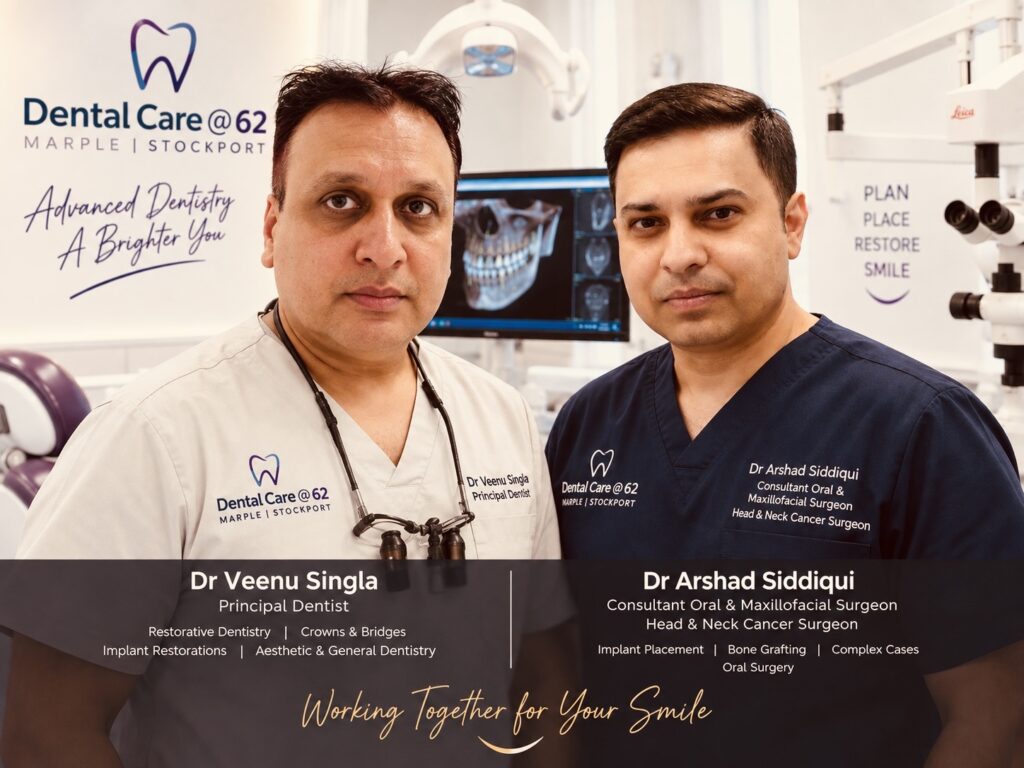
Dr Arshad Siddiqui, Consultant Oral & Maxillofacial Surgeon and Head & Neck Cancer Surgeon, provides dental implant placement at Dental Care @ 62 for suitable patients. Having access to in-house CBCT imaging also allows appropriate cases to be assessed in greater detail where three-dimensional imaging is clinically justified for implant planning.
The restorative part of treatment is then planned around the individual patient, taking into account the position of the missing tooth or teeth, available bone, gum health, bite and the type of final restoration required.
Replacing several missing teeth
When more than one tooth is missing, the best approach is often about restoring the whole mouth rather than treating each gap separately. A partial denture may be practical and cost-conscious for several spaces. A fixed bridge may be possible where strong supporting teeth are available. Implant-supported bridges or dentures can offer added stability in selected cases, but require sufficient bone, good gum health and a commitment to ongoing review.
The condition of the teeth that remain is especially important. If they have active decay, loose fillings, untreated gum disease or repeated infections, these issues should be stabilised first. Building replacement teeth on an unhealthy foundation rarely provides the outcome anyone wants.
How to choose between dentures, bridges and implants
There is no single option that suits every patient. The decision usually comes down to a balance of clinical findings and personal preferences. Your dentist will consider the location of the gap, the condition of neighbouring teeth, your gum and bone health, how you bite together, your general health and the appearance you hope to achieve.
Time and budget are valid practical considerations too. A denture may be completed more quickly and with less invasive treatment. A bridge can be a good fixed option without surgery. Implant treatment can take longer and may involve additional procedures, but may be valuable when preserving adjacent teeth is a priority. Each choice also has different future maintenance needs and potential repair costs.
It is reasonable to ask what happens if you choose no treatment, how long the proposed restoration may be expected to last, what cleaning is required, and what alternatives are available. Clear answers help ensure that your choice is informed rather than rushed.
What happens at a missing-tooth consultation?
A consultation should begin with your concerns. You may be worried about appearance, finding food catches in the gap, a loose denture, or a tooth that has recently failed. Your dentist will examine your mouth, assess your gums and bite, and may take X-rays. More complex cases can sometimes benefit from CBCT imaging to provide a detailed view of the bone and surrounding anatomy.
You should then receive a clear explanation of the suitable options for replacing missing teeth, including any treatment needed first. If you are anxious about dentistry, say so from the outset. Treatment can be paced carefully, with time for questions and agreed breaks, rather than expecting you to simply cope.
A considered next step
Replacing a missing tooth is not only about closing a gap. It is about protecting your oral health, restoring comfortable function and choosing an approach that feels manageable for you. If you are considering your options in Marple, Stockport or the surrounding area, Dental Care @ 62 can provide a careful assessment and talk you through the choices without pressure. Booking a consultation is a practical first step towards a plan that respects both your teeth and your priorities.
Considering your options for replacing missing teeth?
If you have one or more missing teeth, Dental Care @ 62 in Marple, Stockport can assess your oral health and explain the options that may be appropriate for you. Depending on your individual circumstances, these may include dentures, bridges, dental implants or, in some cases, leaving the space untreated.
Contact Dental Care @ 62 to arrange a consultation and discuss your options without pressure.
One comment for “Options for Replacing Missing Teeth: Dentures, Bridges or Implants?”
Dental Implants Stockport | Dental Care @ 62
[…] considering dental implants in Stockport, you may be looking for a fixed way to replace one or more missing teeth. A missing tooth can affect more than your smile — it may change how you chew, what you eat […]