
If you have been told you need a difficult tooth extraction in Stockport, you may understandably have questions about why the removal is more complex and what the procedure involves.
A tooth does not need to be visibly broken to make removal more involved. Roots can curve, separate or sit close to important structures, while an impacted wisdom tooth may be partly covered by bone or gum. If you have been told you need a difficult tooth extraction, the most useful first step is not to worry about the label, but to understand why it is needed, how it will be planned and what choices are available to you.
At Dental Care @ 62 in Marple, treatment is planned around the individual patient. Sometimes this means removing a tooth that cannot be predictably restored. In other cases, careful assessment may show that root canal treatment, restorative treatment or monitoring remains a more appropriate way to preserve the natural tooth.
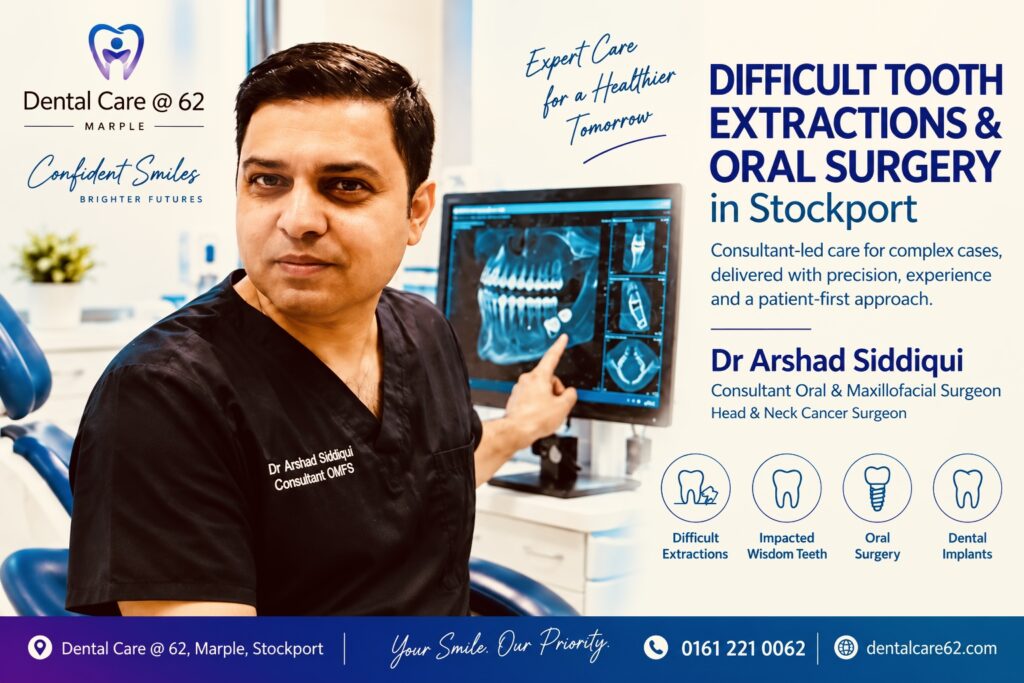
For more complex oral surgical cases, Dental Care @ 62 works with Dr Arshad Siddiqui, Consultant Oral & Maxillofacial Surgeon and Head & Neck Cancer Surgeon. Dr Siddiqui provides oral surgical treatment at the practice, including difficult and surgical extractions, removal of impacted teeth including wisdom teeth, and dental implant placement.
Complex oral surgery at Dental Care @ 62
More complex extractions do not necessarily need to be managed away from the dental practice. Dr Arshad Siddiqui, Consultant Oral & Maxillofacial Surgeon, provides oral surgical care at Dental Care @ 62 for appropriate cases.
This includes difficult and surgical extractions, retained or fractured roots, removal of impacted teeth including wisdom teeth, and other appropriate oral surgical procedures. Dr Siddiqui also provides dental implant placement for suitable patients when replacement of a missing tooth is being considered.
The practice has in-house CBCT imaging, which can be used where clinically indicated to assess three-dimensional anatomy and assist treatment planning for selected complex cases.
Referrals for difficult extractions and oral surgery
Dental Care @ 62 welcomes referrals from dental colleagues for difficult extractions and appropriate oral surgical procedures.
Cases can be assessed and, where appropriate, treated locally by Dr Arshad Siddiqui, Consultant Oral & Maxillofacial Surgeon. This may include impacted wisdom teeth, retained or fractured roots, difficult extractions and other oral surgical cases requiring more advanced assessment or management.
In-house CBCT imaging is available where clinically indicated, allowing appropriate cases to be assessed and treatment planned within the practice.
Following treatment, we aim to communicate clearly with the referring dentist so that the patient can return to their usual dentist for ongoing care.
What makes a tooth extraction difficult?
A difficult extraction is not necessarily an emergency or a sign that anything has gone wrong. It simply describes a tooth whose position, condition or anatomy means that it may need more planning and a more surgical approach than a straightforward removal.
Common reasons include a tooth that has fractured at or below the gum line, very long or curved roots, or roots that are widely spread. Dense surrounding bone can also make removal more challenging. Wisdom teeth are often involved because they may be tilted, trapped beneath the gum, or only partly erupted. Previous infection, limited mouth opening and a crown or large filling that has weakened the remaining tooth structure can add further considerations.
The lower jaw deserves particular care where the roots of a wisdom tooth appear close to the nerve that provides feeling to the lip and chin. In the upper jaw, the relationship between back teeth and the maxillary sinus may be relevant. These are not reasons to assume a problem will occur, but they are reasons to assess the case properly before treatment.
Planning a difficult tooth extraction carefully
A clear examination and suitable imaging are central to safe, thoughtful care. Standard dental X-rays often provide the information required. Where a two-dimensional image does not show the root shape or its relationship with nearby structures clearly enough, a CBCT scan may be recommended. This is a three-dimensional scan that can help the clinician assess the area in greater detail.
CBCT imaging is not necessary for every extraction. It is used where the additional information is likely to influence planning or help explain the options and risks more clearly. This measured approach avoids unnecessary imaging while ensuring complex cases are assessed appropriately.
Your appointment should also include a discussion about your general health, medicines and previous dental experiences. Blood-thinning medication, certain treatments for osteoporosis, diabetes, smoking and a history of difficult healing can all affect the plan. Do not stop prescribed medicine without advice from the clinician or the doctor who prescribed it.
Before proceeding, you should understand why removal is advised, what the procedure may involve, the alternatives, and the likely recovery. If a tooth has a reasonable chance of being saved, it is appropriate to discuss that option. Extraction can be the right choice where infection, fracture or gum disease has left a poor long-term outlook, but it is not treated as the automatic answer.
Could the tooth be saved instead?
This depends on how much sound tooth structure remains, the condition of the roots and surrounding bone, and whether treatment is likely to offer a sensible long-term result. Complex root canal treatment and restorative treatment can sometimes retain a tooth that might otherwise be removed. Equally, repeated treatment on a tooth with a limited outlook may not be in a patient’s interests.
When removal is recommended, it is also worth discussing what happens afterwards. Some spaces can be left without replacement, particularly at the back of the mouth. In other situations, a bridge, denture or dental implant may be considered after healing. The right option depends on the position of the tooth, your bite, oral health and personal priorities.
What happens during the procedure?
Most extractions are carried out using local anaesthetic. This numbs the area so you should not feel sharp pain, although pressure, movement and vibration can be noticeable. If you are anxious, say so early. A calm explanation, planned breaks and an agreed way to signal that you need to pause can make a meaningful difference.
For a more involved procedure, the gum may need to be gently lifted to access the tooth. A small amount of bone may be carefully removed, or the tooth may be divided into smaller sections so that each part can be taken out with less force. Stitches are sometimes used afterwards, often with dissolvable material.
This surgical approach can sound daunting, but it is often the controlled way to remove a tooth while protecting the surrounding bone and soft tissues as far as possible. The exact technique depends on the tooth and cannot always be predicted fully until treatment begins. Your clinician should explain this before obtaining your consent.
Complex cases may be treated locally when appropriate, including where advanced imaging supports careful planning. Occasionally, referral to another service may be the better route because of the tooth’s position, your medical needs or the level of care required. A recommendation to refer is a sign of responsible treatment planning, not a failure of care.
Recovery after a difficult tooth extraction
Healing varies. It is common to have swelling, tenderness and some difficulty opening the mouth for a few days, particularly after lower wisdom tooth removal. These symptoms often reach their peak around the second or third day before gradually settling. Bruising can occur, and the extraction site may look unusual as it heals.
Follow the personalised aftercare instructions you are given. In general, protect the blood clot in the socket during the first day. Avoid vigorous rinsing, spitting, smoking and alcohol, and choose soft, cooler foods until chewing is comfortable. After 24 hours, gentle warm salt-water rinses may help keep the area clean if advised. Continue cleaning the rest of your mouth as normal, taking care around the wound.
Use pain relief only as advised by your clinician, pharmacist or doctor. Antibiotics are not routinely needed after every extraction; they are prescribed when there is a clear clinical reason. This helps ensure medicines are used responsibly and effectively.
When should you contact the practice?
Some discomfort is expected, but worsening pain several days after an extraction can be a sign that the blood clot has broken down too early, sometimes called dry socket. Increasing swelling, persistent bleeding, a bad taste with fever, or difficulty swallowing or breathing also need prompt advice. If you are worried at any stage, it is better to get in touch than to try to manage a concern alone.
Questions patients often ask
How long does a difficult extraction take?
There is no reliable fixed time. A tooth that appears straightforward on an X-ray may need additional care, while a planned surgical extraction can sometimes be completed efficiently. Allow enough time for assessment, treatment and clear aftercare advice rather than focusing on the clock.
Will I need time off work or school?
Many people return to gentle activities the next day after a routine removal. For a difficult extraction, especially an impacted wisdom tooth, allowing two or three days of lighter commitments can be sensible. Your clinician can give more individual guidance based on the procedure and your work or school routine.
Can a nervous patient have a difficult extraction?
Yes. Nervousness is common and never a reason to delay asking for help. Let the team know what concerns you, whether that is needles, sounds, a previous difficult experience or fear of losing control. A slower pace, straightforward explanations and planned pauses can help you feel more prepared.
Need a difficult tooth extraction in Stockport?
If you have a broken or heavily damaged tooth, retained roots, an impacted or troublesome wisdom tooth, or have been told that an extraction may be more complex, contact Dental Care @ 62 in Marple for an assessment.
More complex oral surgical cases can be assessed and treated where appropriate by Dr Arshad Siddiqui, Consultant Oral & Maxillofacial Surgeon, with in-house CBCT imaging available when clinically indicated. Patients can contact us directly, and professional referrals from dentists are welcome.
0 comments on “Difficult Tooth Extraction in Stockport: When Is a Surgical Extraction Needed?”